Services

Events & Experiences
Enterprise & Training
Gaming & Education


Everything a government entity, developer, tourism authority, or brand needs to know about building an experience centre in Dubai, Abu Dhabi, Saudi Arabia, Qatar or Oman, from definition to delivery.

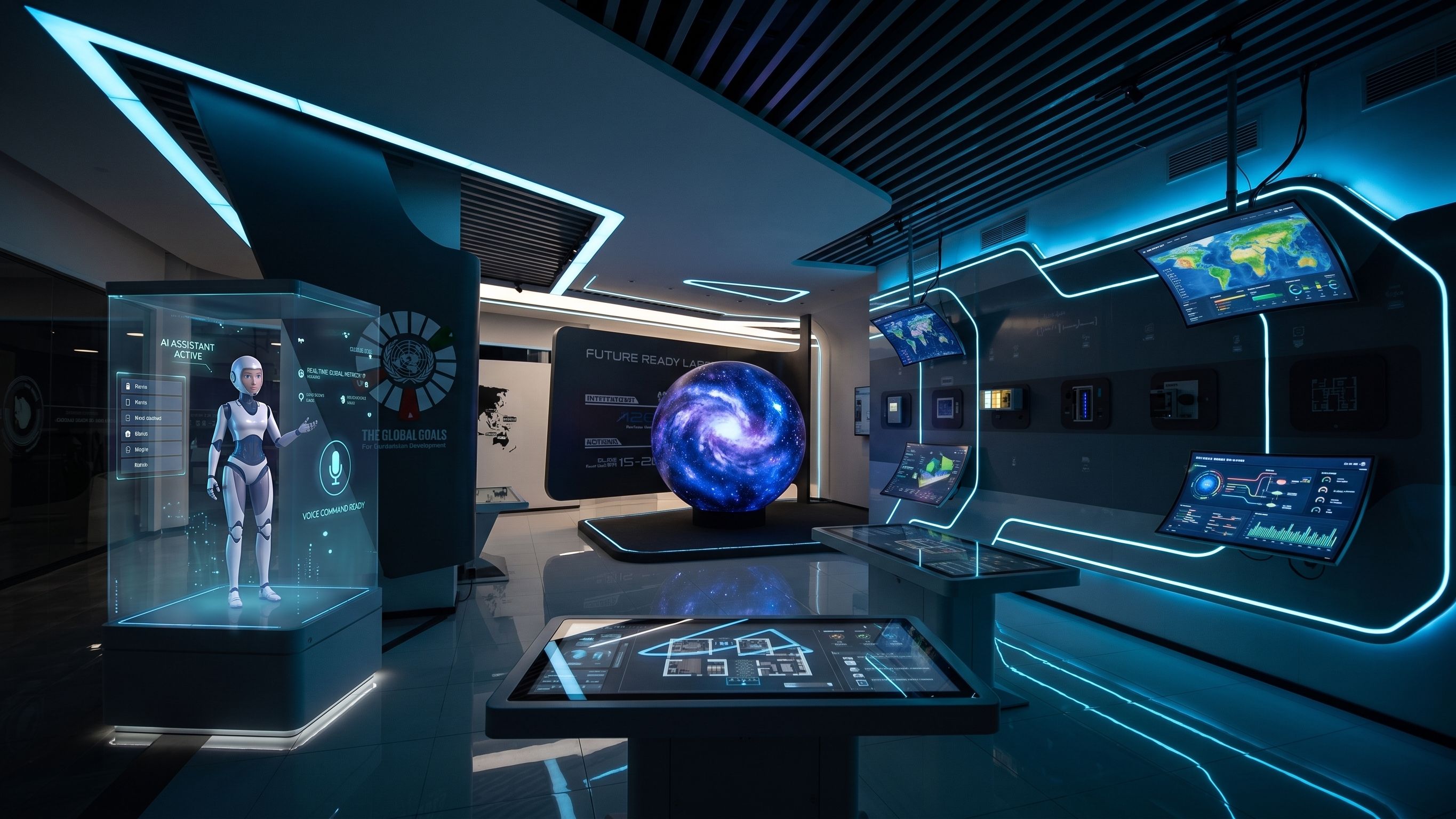
From the Museum of the Future on Sheikh Zayed Road to Diriyah's heritage-tech pavilions outside Riyadh, the GCC has become one of the most active experience-centre markets in the world. Governments are funding them as national showcases, developers are using them to sell giga-projects before a single tower is finished, and brands are opening them to turn a showroom visit into something people queue up for and post online.
This guide is the complete, practical reference: what an experience centre actually is, how the market is developing across Dubai, Abu Dhabi, Saudi Arabia, Qatar and Oman, what technology goes inside one, what it costs, how to choose the right partner, and how Power Interactive delivers experience centres end to end across the region.
QUICK ANSWER: An experience centre is a purpose-built physical space that uses interactive technology, spatial design, and storytelling to let visitors engage directly with a brand, destination, or idea, rather than simply viewing it. Unlike a showroom or museum gallery, an experience centre is designed around a visitor journey: a sequence of connected, often technology-driven moments that build toward a single message or outcome.
Experience centres go by several names depending on who's building them, brand experience centres, customer experience centres, visitor centres, innovation centres, digital experience centres, but they share the same underlying idea: the space itself is the message. Instead of reading about a company, a destination, or a national vision on a wall panel, a visitor walks through it, touches it, and reacts to it.
Three elements are present in almost every experience centre, regardless of who built it or why:
1. A visitor journey: a designed sequence of zones or moments, not a single room of static displays. Visitors move from an opening "hook" through deeper engagement to a closing message or call to action.
2. Interactive technology: touchscreens, projection, LED walls, sensors, and increasingly AI and robotics, that respond to the visitor rather than playing on a loop regardless of who's in the room.
3. A clear narrative purpose: every experience centre exists to communicate something specific: a brand's values, a government's vision, a destination's story, or a product's capability. The technology serves the story, not the other way around.
That last point is the one buyers get wrong most often. An experience centre isn't a shopping list of screens and sensors, it's a communication strategy that happens to be built using screens and sensors. The best-performing experience centres in the region were designed narrative-first, technology-second.
QUICK ANSWER: A showroom displays products for people to view or purchase. A museum exhibit displays information or artifacts for people to learn from. An experience centre does neither on its own, it puts the visitor inside a designed, interactive journey built to change how they feel about a brand, place, or idea, using technology that responds to their presence and choices.
The distinction matters because it changes what you're actually commissioning. A showroom fit-out is largely about product display, lighting, and merchandising. An experience centre is a piece of communication architecture, closer to a documentary film or a piece of theatre than a retail fit-out, one that happens to be walked through rather than watched from a seat.
Three practical differences follow from that:
Pacing is designed, not incidental. An experience centre is sequenced deliberately, an opening moment that stops people, a build that deepens engagement, and a closing moment that leaves an impression, the same three-act structure that makes any story work.
The visitor is a participant, not an observer. Sensors, touch surfaces, and responsive content mean the space reacts differently depending on who's in it and what they do, which is what makes people stay longer and remember more than they would from a static display.
Success is measured in dwell time and message retention, not just footfall. A showroom's job is largely done once someone walks in. An experience centre's job isn't done until the visitor leaves understanding, and ideally repeating, the specific story it was built to tell.
QUICK ANSWER: The GCC is one of the fastest-growing experience centre markets in the world, driven by Saudi Arabia's Vision 2030 giga-projects, the UAE's tourism and innovation strategy, and Qatar and Oman's parallel pushes into experience-led tourism. Governments and developers across all five markets are funding experience centres as flagship tools to sell destinations, giga-projects, and national visions before physical construction is complete.
Each market is moving for slightly different reasons, but the direction is the same everywhere: experience centres have gone from a "nice to have" marketing tool to strategic infrastructure.
Dubai set the regional benchmark. The Museum of the Future, a 77-metre torus-shaped landmark on Sheikh Zayed Road that opened in 2022, has welcomed more than 4 million visitors and is regularly ranked among the most architecturally significant museums in the world, proof that an experience centre can become a genuine tourism destination in its own right, not just a marketing exercise. Expo City Dubai has continued that momentum post-Expo 2020, repurposing pavilions into permanent experience and innovation spaces. For developers, corporates, and government entities in Dubai, the bar for what an "experience centre" needs to deliver has been set very high, and very publicly.
Abu Dhabi's approach leans toward heritage and governance storytelling delivered through contemporary technology. Qasr Al Watan, the presidential palace opened to the public in 2019, uses interactive displays and immersive media to tell the story of UAE governance and craftsmanship inside a working seat of government, a model increasingly referenced by other GCC entities looking to combine national narrative with visitor experience. Abu Dhabi's cultural and government sector continues to fund large-scale visitor and briefing experiences as part of its broader tourism and innovation diversification strategy.
Saudi Arabia is currently the single largest driver of experience centre demand in the region. Vision 2030 giga-projects, NEOM, Diriyah Gate, Qiddiya, Red Sea Global, and others, all require experience centres and sales/visitor pavilions to sell scale and ambition to investors and future residents years before physical delivery. The Kingdom is targeting 150 million visits annually by 2030 and has awarded over $196 billion in Vision 2030-related contracts since 2016, a scale of investment that has made Saudi Arabia the fastest-growing experience centre market in the GCC, and one where relatively few specialist regional integrators have yet established themselves, a genuine opportunity for an early, credible mover.
Qatar's Tourism Strategy 2030 targets 6 million visitors annually and explicitly names museums and cultural experiences as one of its core pillars. The National Museum of Qatar and a wave of newer cultural venues have leaned heavily into interactive technology, RFID-enabled visitor tracking, immersive video walls, spatial soundscapes, and AR-guided tours, positioning Doha as a serious experience-centre market in its own right, not just an events and sports hub.
Oman's approach is more measured but accelerating. OMRAN Group's tourism development strategy is bringing new visitor experience investment across the Sultanate's heritage and hospitality sector, with a clear signal that Oman intends to compete on visitor experience quality, not just natural scenery, as its tourism sector scales.
The throughline across all five markets: governments and developers are funding experience centres not as an afterthought to a bigger project, but as the first thing investors, tourists, and citizens see, which is exactly why the quality bar, and the commercial stakes, are so high.
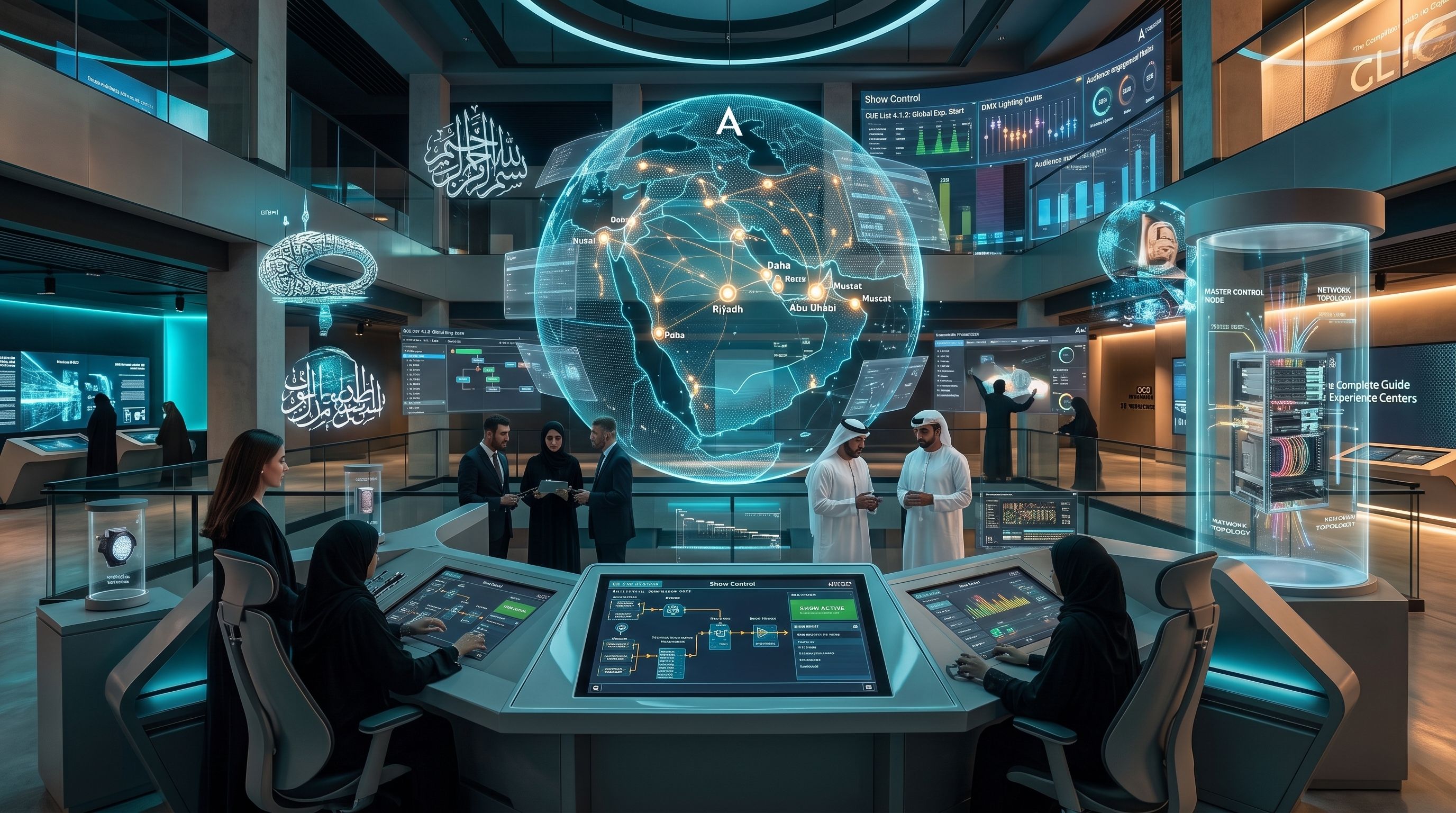
QUICK ANSWER: A modern experience centre typically combines interactive displays and touchscreens, projection and projection mapping, LED walls, immersive rooms, show control to synchronize it all, and increasingly AI-driven personalization, sensors, and robotics, arranged into a sequence of zones that guide the visitor from entry to a closing message.
Technology is never the point of an experience centre, it's the toolkit. Here's what typically goes into that toolkit, and where each piece earns its place.
| Technology | What It Does | Best For |
|---|---|---|
| Interactive Displays & Touchscreens | Let visitors explore content, configure products, or access detail on demand | Product configurators, information zones |
| Projection & Projection Mapping | Wraps content across walls, floors, and architectural surfaces | Opening "wow" moments, storytelling zones |
| LED Walls & Video Walls | High-brightness, high-impact visual content at scale | Hero moments, branded entry sequences |
| Immersive Rooms | Multi-surface, often floor-to-ceiling synchronized content | Full-sensory storytelling, flagship centrepieces |
| Show Control | Synchronizes every system above to a single, visitor-triggered timeline | Every experience centre with more than one system |
| Sensors & Interactive Triggers | Detect visitor presence, touch, or movement to trigger a response | Personalized, responsive journeys |
| AI & Robotics | Personalizes content in real time or adds a physical, characterful element | Flagship or innovation-forward centres |
Type card — Interactive Displays & Configurators: The workhorse of most experience centres, letting a visitor explore, customize, or drill into content at their own pace. Usually the fastest and most cost-effective zone to build, and the one most centres start with.
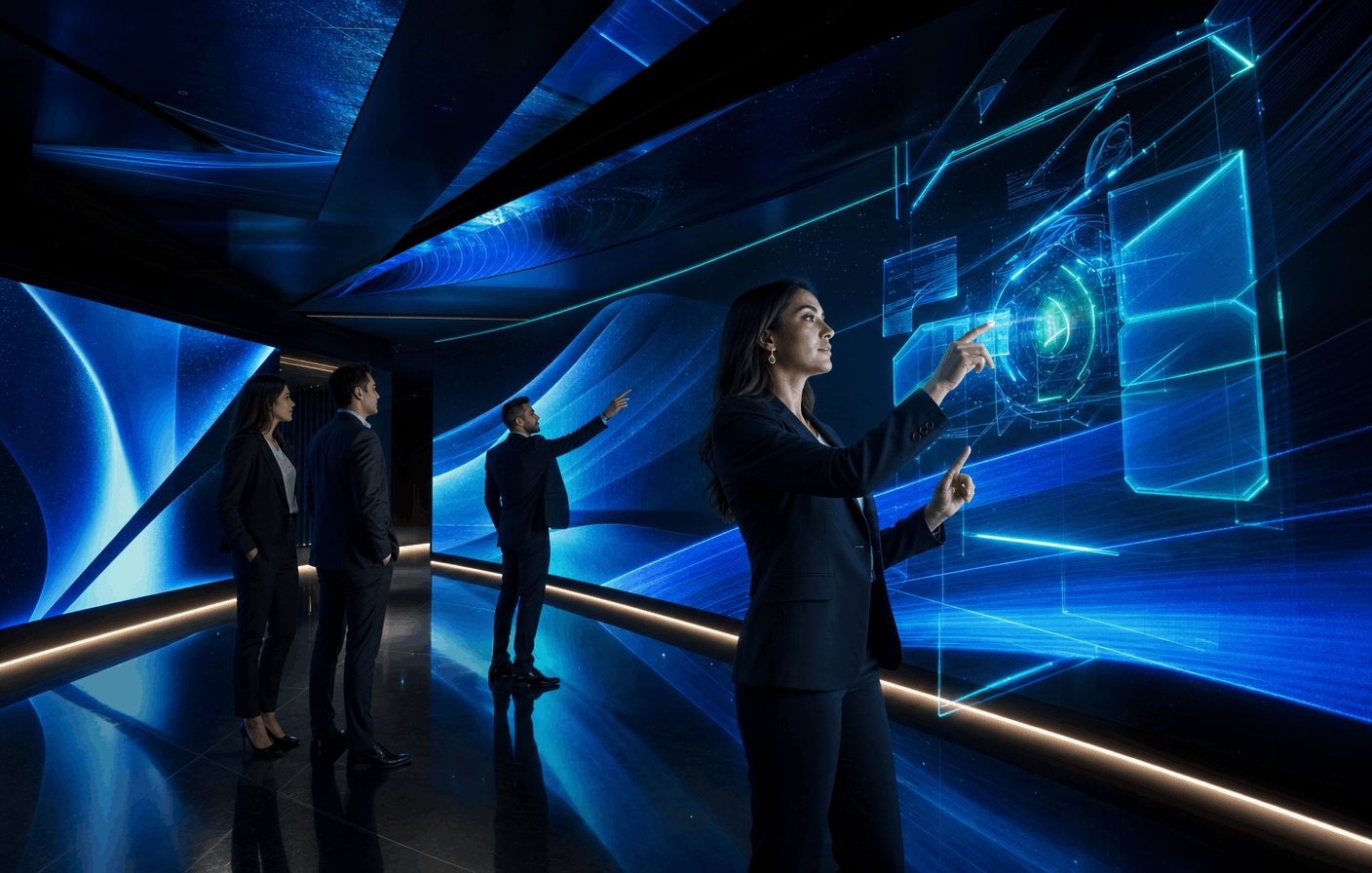
Type card — Immersive Rooms & Projection: The centrepiece most visitors remember and photograph. Multi-surface projection or LED, synchronized through show control, is what turns a corridor of screens into a genuine "moment."
Type card — Sensor-Driven Interactivity: What separates an experience centre from a very expensive video wall: content that changes based on who's there, how many people, how they move, what they touch, so no two visits feel identical.
Type card — AI & Robotics: The newest, most differentiating layer. AI-personalized content and physical robotic elements are still relatively rare in the region, which makes them a strong differentiator for a flagship centre willing to invest in being first.
QUICK ANSWER: Experience centres are commissioned by government entities, tourism authorities, master developers, corporates, and brands, and are built for investors, tourists, citizens, customers, and delegations, essentially, anyone the commissioning organization needs to convince, inform, or impress in person.
The commissioning logic differs by sector, but the underlying need is consistent: a physical space that does a better job of persuading a visitor than a brochure, a website, or a sales deck ever could.
QUICK ANSWER: The biggest shifts in experience centre design in 2026 are AI-driven personalization of the visitor journey, a move toward multi-sensory (not just visual) storytelling, hybrid physical-digital experiences that extend beyond the visit itself, and sustainability becoming a genuine design requirement rather than an afterthought.
AI-personalized journeys: Experience centres are starting to tailor content in real time based on who's in front of a sensor, group size, language, even prior interaction, rather than running the same fixed sequence for every visitor.
Multi-sensory storytelling: Spatial audio, scent, temperature, and haptic feedback are increasingly layered alongside visuals, since visual-only immersion has become table stakes across the region's best venues.
Hybrid physical-digital extension: Leading centres now extend the visit digitally, AR companion apps, post-visit content, and shareable digital souvenirs, so the experience's reach outlasts the physical visit.
Sustainability as a design requirement: With Red Sea Global and other GCC giga-projects committing publicly to regenerative and sustainable development, experience centres attached to those projects increasingly need to reflect those values in material choice and energy use, not just message them on a screen.
QUICK ANSWER: Evaluate a potential experience centre partner on four things: whether they design the narrative and visitor journey first (not just sell hardware), whether they can deliver end to end (design, content, technology, and installation under one roof), their track record with permanent, daily-operating installations rather than one-off events, and their ability to support and maintain the centre after launch.
Step 1, Check whether they lead with story or with hardware. Ask a prospective partner to walk you through their process. If the first conversation is about screen specifications rather than your visitor journey and message, that's a signal.
Step 2, Confirm end-to-end capability. Experience centres that involve multiple vendors for design, content, technology, and installation create integration risk and unclear accountability when something doesn't work on opening day. A single accountable partner is almost always the safer commercial choice.
Step 3, Ask about permanent-installation experience specifically. Building something that looks impressive for a three-day event is a very different discipline from engineering a system that runs flawlessly, multiple times an hour, every day, for years. Ask directly how many permanent (not temporary/event) installations they've delivered.
Step 4, Understand their regional delivery capability. A partner unfamiliar with GCC-specific realities, import logistics, local commissioning, Ramadan operating schedules, government approval processes, will cost you time and budget a regionally established partner won't.
Step 5, Ask what happens after launch. The best experience centres get refreshed, maintained, and content-updated for years after opening. A partner who disappears after handover isn't a long-term fit for a permanent installation.
QUICK ANSWER: Experience centre costs vary enormously by scale and technology mix, industry benchmarks for interactive installation components alone typically range from roughly $15,000 for a single simple interactive touchpoint to $200,000+ for a flagship multi-system zone, with technology and content together often consuming more than half of a project's total budget. A full experience centre combining multiple zones is a multi-hundred-thousand to multi-million-dollar investment depending on scope, and a tailored quote based on your specific space and goals is the only accurate way to price one.
A published price list would be misleading, every experience centre's scope, technology mix, and content complexity is different. What's useful is understanding the levers that move the number:
01 — Number and complexity of zones. A single interactive wall sits at one end of the spectrum; a multi-zone journey combining immersive rooms, projection, robotics, and AI personalization sits much higher.
02 — Custom content production. Often the most underestimated cost. Bespoke narrative content, 3D assets, and multi-language storytelling are a genuine creative production effort, not a line item.
03 — Show control & systems integration. The more systems that need to be synchronized (audio, lighting, projection, robotics, sensors), the more integration engineering the project requires.
04 — Permanent vs. temporary. A permanent installation needs to be engineered for years of daily operation and easier long-term maintenance, a materially different (and typically higher upfront) investment than a temporary activation.
Additional factors to anticipate: ongoing content refresh cycles, on-site staffing and operational training, maintenance and support contracts, and regional logistics (import, local commissioning, and compliance). As a general industry reference point, interactive installation components alone are commonly benchmarked in four tiers, Starter ($15K–$30K), Standard ($40K–$80K), Premium ($100K–$200K), and Enterprise ($200K+), though GCC-specific experience centre projects, which typically combine multiple zones and significant custom content, regularly exceed these single-component benchmarks in total. The only reliable way to get an accurate number for your project is to share your goals, space, and timeline for a tailored quote.
QUICK ANSWER: Power Interactive has delivered 800+ experiential technology projects across the UAE, Saudi Arabia, Oman, and the wider GCC since 2018, for clients including DEWA, the Government of Dubai, Atlantis The Royal, Emaar, Adidas, Louis Vuitton, Gucci, and Hugo Boss, combining experience design, interactive technology, and show control under one roof, purpose-built for the region's giga-projects, government entities, and flagship brands.
The GCC's experience centre boom has created enormous demand, but relatively few partners in the region combine narrative-led design, in-house technology capability, and real permanent-installation delivery experience under one roof. That gap is exactly where Power Interactive operates.
Regional delivery, not a fly-in vendor. Based in Dubai and delivering across the UAE, Saudi Arabia, Oman, and the wider GCC, Power Interactive understands the region's approval processes, logistics, and operating realities that trip up partners unfamiliar with the market.
A track record with the region's most demanding clients. 800+ delivered projects since 2018 for organizations including DEWA, the Government of Dubai, Atlantis The Royal, Emaar, Adidas, Dyson, Hugo Boss, Gucci, and Louis Vuitton, proof of both technical capability and the trust of the region's most exacting brands and government entities.
End-to-end capability under one roof. Experience design, interactive and immersive technology, AR/VR/MR, kinetic and robotic installations, projection mapping, and show control are all delivered in-house, meaning one accountable partner for the entire journey, not a chain of subcontractors.
Built for permanent, daily operation. Power Interactive's permanent interactive installations are engineered for museums, experience centres, and giga-project visitor centres that need to run flawlessly, every day, for years, not just look impressive on opening night.


An experience centre is a purpose-built physical space that uses interactive technology, spatial design, and storytelling to let visitors engage directly with a brand, destination, or idea, rather than simply viewing static displays. It's built around a designed visitor journey, not a single room of screens.
A showroom displays products for viewing or purchase. An experience centre puts the visitor inside a sequenced, interactive journey designed to change how they feel about a brand, place, or idea, using technology that responds to their presence rather than playing on a fixed loop.
Most experience centres combine interactive displays and touchscreens, projection and projection mapping, LED walls, immersive rooms, sensor-driven interactivity, and show control to synchronize all of it. Leading centres are increasingly adding AI personalization and robotics.
It depends heavily on the number of zones, how much custom content is produced, how many systems need to be integrated, and whether the build is permanent or temporary. Industry benchmarks for individual interactive components range from roughly $15,000 to $200,000+, while a full multi-zone experience centre is typically a multi-hundred-thousand to multi-million-dollar investment. A tailored quote based on your specific project is the only accurate way to price one.
Saudi Arabia is currently the largest driver of demand, fuelled by Vision 2030 giga-projects like NEOM, Diriyah Gate, and Qiddiya. The UAE (Dubai and Abu Dhabi) set the regional benchmark with landmarks like the Museum of the Future and Qasr Al Watan. Qatar and Oman are both scaling investment as part of their national tourism strategies.
Government entities and tourism authorities, master developers (especially for giga-project sales centres), corporate innovation teams, brands, museums, and increasingly event and marketing agencies building semi-permanent activations.
Timelines vary by scope, but a typical multi-zone experience centre, from initial concept through design, content production, technology integration, and installation, commonly takes 4 to 9 months, longer for large, multi-system flagship builds.
Often, yes. Many experience centre projects are retrofits of existing spaces, adding interactive technology, show control, and redesigned visitor flow to a space that already exists, rather than new-build construction.
Power Interactive designs, builds, and delivers experience centres and interactive technology installations across Dubai, Abu Dhabi, Saudi Arabia, Qatar, Oman, and the wider GCC, with 800+ delivered projects since 2018 for clients including DEWA, the Government of Dubai, Atlantis The Royal, and leading global brands.
Yes. Power Interactive provides ongoing maintenance, content updates, and technical support for permanent installations, so the experience centre continues running reliably and stays current long after opening day.

.png)
.png)
Power Interactive is a Dubai-based experiential technology company, building immersive experiences, interactive installations and Pro AV systems for clients across the UAE, Saudi Arabia and the GCC.