Services

Events & Experiences
Enterprise & Training
Gaming & Education


At a show with thousands of competing stands, the biggest screen no longer wins. This is what the attention research actually says, the six mechanisms that make visitors stop, and how to choose between them based on what you need the stand to achieve.
.png)
.png)
Every year I hear the same post-show conversation: the stand looked excellent, the LED was enormous, the footfall figure was healthy, and the sales team came away with very little. Nobody did anything wrong. The stand simply never caused anyone to stop.
This article is about why that happens and what actually changes it. It is not a list of our products. It is about visitor behaviour, because that is the thing your budget is really competing against.
QUICK ANSWER: Research on exhibition behaviour suggests visitors spend around seven seconds at a stand before deciding what to do, with average attention spans of roughly eight to fifteen seconds. Whatever your stand is going to achieve has to begin inside that window.
Seven seconds is less time than it takes to read a headline properly. Within that window the visitor is not evaluating your proposition, they are making a fast, largely subconscious decision about whether this is worth slowing down for. Published work on booth psychology puts the broader first-impression window at about thirty seconds, with colour alone contributing a large share of the information that forms the impression.
Now put that against the scale of the shows in this region. GITEX Global 2026 is expected to bring together more than 6,800 exhibiting companies and over 200,000 attendees from 180-plus countries. Gulfood runs with 5,000-plus exhibitors and 97,000-plus trade visitors. The Big 5 gathers 2,500-plus exhibitors and 60,000-plus construction professionals.
A visitor cannot meaningfully evaluate thousands of stands. They are not trying to. They are filtering ruthlessly, and your stand is being filtered by a mechanism that operates faster than conscious thought.
QUICK ANSWER: Every exhibitor has responded to the attention problem the same way, more screens, larger LED, more content, louder audio. When everyone escalates simultaneously, the escalation stops differentiating anyone. Scale has become the baseline, not the advantage.
Walk any major hall now and the pattern is obvious: more screens, bigger LED walls, more content playing at once, more competing stands, more noise. Fifteen years ago a large screen was itself the interruption. Today it is wallpaper. The visitor's eye has fully normalised to it.
This is a straightforward arms race with the usual outcome. When every stand raises its visual volume by the same amount, relative attention returns to where it started — except everyone is now spending considerably more to hold the same position. It is the single most expensive habit in exhibition marketing.
There is a second problem with the big-screen approach, which is that a screen playing a loop asks nothing of the visitor. It is broadcast. Broadcast is easy to walk past precisely because walking past costs the visitor nothing, they can see the whole proposition from six metres away and keep moving.
What actually interrupts a walk is something the visitor cannot fully resolve from the aisle.
QUICK ANSWER: Six mechanisms reliably convert passing traffic into engagement: movement creates curiosity, interaction creates participation, gamification creates competition, object recognition creates discovery, immersion creates attention, and personalisation creates relevance. Each suits a different objective.
Movement creates curiosity. A kinetic installation attracts attention because something in the physical environment is genuinely changing. The human visual system is built to detect motion, it is involuntary, and it works at the edge of peripheral vision, which is precisely where your stand sits when someone is walking past it. A screen showing motion is not the same thing; the eye has learned to discount video. Physical movement in real space has not been discounted, which is why a kinetic wall or a robotic element still turns heads in a hall full of LED.
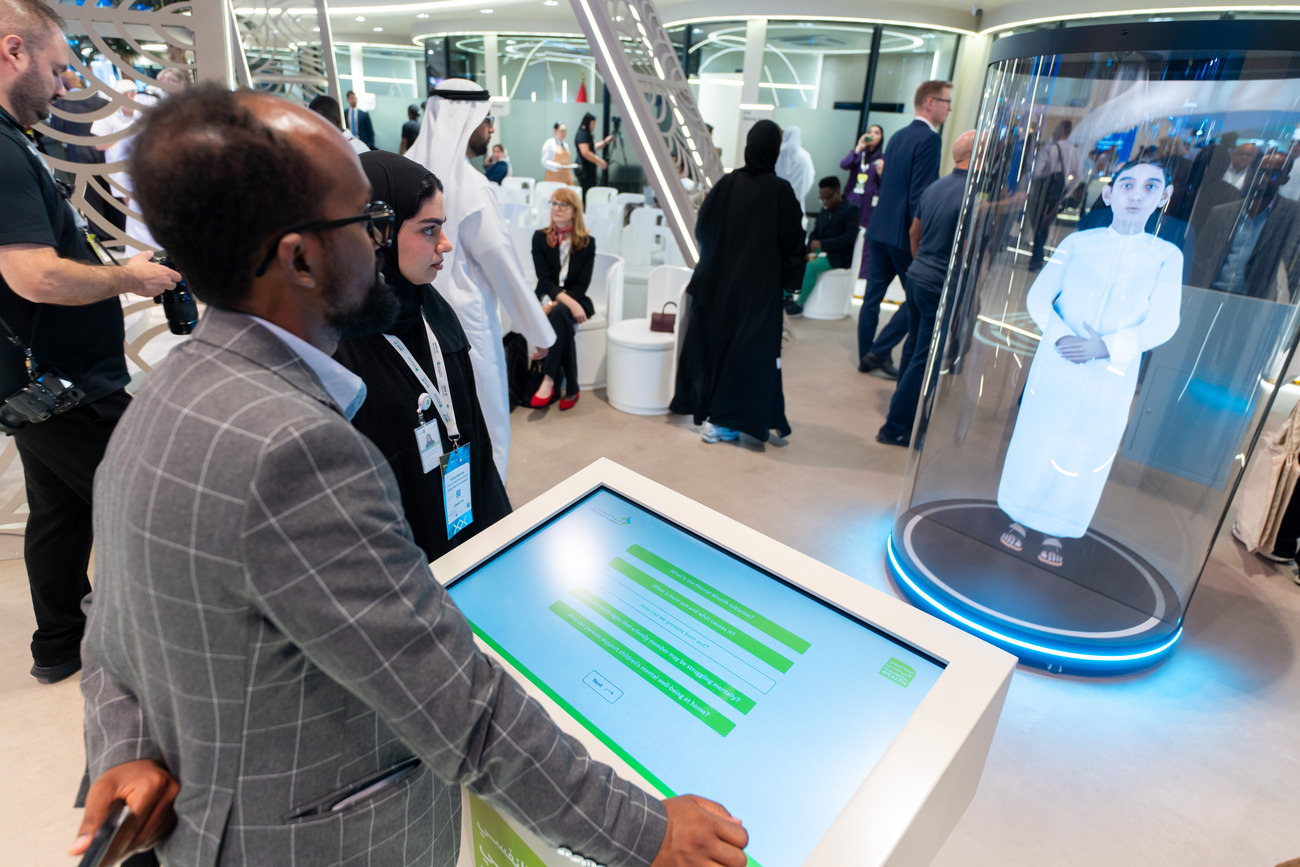
Interaction creates participation. The moment a visitor touches something, their relationship to the stand changes: they are no longer an audience, they are involved. This is also the point at which your staff get a natural opening, approaching someone already engaged with your content is far easier, for both parties, than intercepting a walker. Interaction is the mechanism that most reliably lifts dwell time.
Gamification creates competition. A game with a visible score or leaderboard does two things a static experience cannot: it extends dwell, because people finish what they start, and it produces return visits, because people come back to reclaim a position. On multi-day shows this is unusually valuable, a leaderboard turns day one visitors into day three visitors. It also creates a natural, non-intrusive reason to capture a name.
Object recognition creates discovery. Place a physical product on a surface and have the environment respond with information about it. The interaction requires no instruction because picking something up is already familiar, and it lets a visitor explore a complex portfolio at their own pace and in their own order. For technical products, specification-heavy ranges or anything with more variants than a wall can display, this converts a catalogue into an exploration.
Immersion creates attention. Surrounding a visitor with content removes the competing stimuli of the hall. That is the actual mechanism, not spectacle, but the exclusion of everything else. It buys you the one thing no open stand can: a captive, undistracted few minutes. This is why domes and enclosed environments perform disproportionately well on stands where there is a story to tell rather than a product to demonstrate.
Personalisation creates relevance. Content that responds to who the visitor is their sector, their language, their role feels addressed to them rather than broadcast at them. For senior visitors in particular, the perception that the stand adjusted to them is often what earns the conversation.
QUICK ANSWER: Average dwell at a visited stand is now roughly 4.2 minutes, down from 5.8 in 2019. But the spread is enormous: the top 10% of spaces hold engaged visitors for over 33 minutes, the bottom 10% for under 4. The gap between them is design, not luck.
Useful benchmarks from published industry measurement:
Set your target from the spread, not the average. If your stand is achieving four minutes, you are normal, and normal is the problem. The stands reaching thirty minutes are not doing the same thing better — they are doing something structurally different, which is almost always one of the six mechanisms above rather than a larger screen.
QUICK ANSWER: Published analysis suggests a stand run by trained, briefed staff sees three to five times the average dwell time of one staffed by an unprepared internal team. No installation, at any budget, compensates for people standing behind a counter looking at their phones.
I am a technology supplier telling you that the largest single variable on your stand is not technology. That is worth saying plainly, because it is consistently true and rarely said by anyone selling something.
The mechanisms in Section 3 create the opening. Your people convert it. A visitor who has just played your game, handled your product or stepped out of your dome is, for about ten seconds, maximally approachable — and if nobody approaches, that moment closes and they walk. We have watched genuinely excellent installations underperform for exactly this reason.
Three things that consistently separate stands that convert from stands that do not:
Brief the staff on the technology, not just the products. They need to be able to invite someone into the interaction confidently. Staff who do not understand an installation avoid it, and visitors follow their lead.
Position people to receive, not to intercept. Standing at the aisle edge intercepting walkers has a low success rate and makes the stand feel like a gauntlet. Standing near the point where people finish an interaction has a high one.
Decide what a qualified conversation sounds like before the show. Otherwise the team has friendly chats, and you count footfall instead of pipeline.
QUICK ANSWER: Brief the outcome first, then select the mechanism. Awareness points toward movement and immersion; lead generation toward gamification and interaction; complex product education toward object recognition; a launch toward immersion and personalisation.
This is the part that most exhibitors get backwards. The conversation usually starts "we want something interactive" or "we want a hologram," which is choosing from a catalogue rather than solving a problem. Start here instead:
Two practical tests before signing anything off:
The aisle test. Can a visitor tell, from six metres away and in about two seconds, that something is happening here that they cannot fully see from there? If the whole proposition resolves from the aisle, there is no reason to stop.
The "so what" test. After the visitor has engaged, does the experience hand them to a conversation, a next step or a capture point? An interaction that entertains and then releases people back into the aisle has produced dwell and nothing else.
QUICK ANSWER: Stand position and internal layout materially affect traffic before any technology is installed. Corner and intersection positions receive roughly double the exposure of linear rows, and open frontage with a visible interaction point outperforms enclosed or counter-fronted designs.
Take the intersection if you can. Booths at the crossing of major aisles get roughly twice the exposure of stands in a linear run, because visitors naturally slow at intersections. This is decided at floor-plan booking, months before design begins, and it is one of the highest-leverage decisions available.
Do not barricade the front. A counter across the frontage reads as a boundary. Visitors interpret it correctly, as a place where they will be asked questions and avoid it. Put the interaction where it can be seen and reached from the aisle.
Design for the crowd you want. A small crowd is the strongest attractor at any exhibition; people stop where other people have stopped. That means leaving room for a group to form without blocking the aisle, which is a layout decision.
Plan the exit. Where does someone go after the interaction ends? If the answer is "back into the aisle," you have designed a diversion rather than a funnel.
QUICK ANSWER: Footfall is not performance. Measure engagement rate, dwell distribution rather than average, and visitor-to-lead conversion, and then follow the leads up, because industry analysis suggests up to 80% of trade show leads never receive any follow-up at all.
Engagement rate, not footfall. What share of people who passed actually interacted? This is the number that tells you whether the stand is doing its job.
Dwell distribution, not dwell average. A stand where most people glance for fifteen seconds and a few stay twenty minutes reports the same average as one where everyone stays four. Those are different outcomes. Ask what proportion reached genuine depth.
Visitor-to-lead conversion. In the 10–30% range is a far more honest measure of stand performance than raw badge scans.
And then actually follow up. This is the most expensive failure in the entire category: up to 80% of trade show leads receive no follow-up, and companies responding within 24 hours are several times more likely to convert than those waiting a week. You can spend a fortune on a stand and lose all of it in the week afterwards.
QUICK ANSWER: We build the technology that goes inside stands, kinetic, interactive, gamified, object-recognition, immersive and personalised experiences, rather than the stands themselves, working alongside your stand builder and agency. More than 800 delivered projects since 2018 across the UAE, Saudi Arabia, Oman and the wider GCC.
A clarification that saves everyone time: we are not a stand builder. We do not fabricate shells, and we are not competing with your contractor. We supply and integrate the experience inside the stand, and we work alongside stand builders and agencies on most projects we deliver.
We start from the objective. The first conversation is about what the stand has to achieve and for whom, not which technology you would like. Frequently the recommendation is a smaller, sharper intervention than the one originally imagined.
We build for show conditions. Exhibition environments are unforgiving: compressed build windows, heavy public handling, ambient light and noise, and no tolerance for downtime during show hours. That is a different engineering standard from a showroom piece, and it is designed in rather than hoped for.
We cover the mechanisms in-house. Kinetic and robotic installations, interactive technology, content and app development, AR/VR/MR, projection and Pro AV sit within one team, so the mechanism gets chosen on merit rather than on what one supplier happens to sell.
We work at regional show scale. GITEX, Gulfood, The Big 5, COP28 and the major Riyadh shows have different build, access and compliance realities, and having delivered into them repeatedly is what keeps a programme on schedule when the hall opens.
More than 800 delivered projects since 2018 for clients including DP World, DEWA, the Government of Dubai, Emaar, Adidas, PlayStation, Hugo Boss and Louis Vuitton.
Author: Fahad Javaid is Founder and CEO of Power Interactive, a Dubai-based immersive technology studio. This article is written from more than 800 experiential technology projects designed, engineered and delivered across the UAE, Saudi Arabia, Oman and the wider GCC since 2018.


Because they are filtering, not browsing. Research suggests visitors spend around seven seconds at a stand before deciding what to do, with attention spans of roughly eight to fifteen seconds. At a show like GITEX with 6,800-plus exhibitors, a visitor cannot evaluate everything, so anything that can be fully understood from the aisle gets filtered out. Stands that stop people usually contain something the visitor cannot resolve from a distance.
Average dwell at a visited stand is roughly 4.2 minutes, down from 5.8 minutes in 2019. But the spread matters far more than the average: the top 10% of spaces hold engaged visitors for over 33 minutes while the bottom 10% manage under four. Aim at the top of the distribution, and measure what proportion of visitors reach real depth rather than reporting an average.
Six mechanisms reliably work: physical movement (kinetic installations), interaction, gamification with a leaderboard, object recognition, immersion in an enclosed environment, and personalised content. Which is "best" depends entirely on your objective — gamification suits volume lead capture, object recognition suits complex products, immersion suits storytelling and launches.
Not any more. When every exhibitor increases screen size simultaneously, relative attention returns to where it started while everyone spends more. A screen also asks nothing of the visitor and can be understood from the aisle, which makes it easy to walk past. Physical movement and interaction interrupt a walk more reliably than scale does.
It varies widely by mechanism and scale. As rough guidance, a single well-executed interactive station sits at the lower end, a bespoke room-scale or immersive feature in the middle, and a multi-element hero stand considerably higher. Our full cost guide breaks down what drives the number and what each budget level realistically delivers.
Gamification works well for dwell time, repeat visits across multi-day shows and natural data capture. The caution is that a game must connect to something, if visitors play, enjoy it and walk away without a conversation or a capture point, you have bought entertainment rather than pipeline.
The staff, by a wide margin. Published analysis suggests stands run by trained, briefed teams see three to five times the dwell of those staffed by unprepared internal teams. Technology creates the opening; people convert it. Brief your team on the installation itself, not only the products.
Engagement rate (share of passers-by who interacted), dwell distribution rather than average, and visitor-to-lead conversion in the 10–30% range. Then follow up fast, industry analysis indicates up to 80% of trade show leads never receive any follow-up, and responding within 24 hours makes conversion several times more likely.
.png)
.png)
.png)
We design and build immersive experiences that engage, excite and transform audience interaction combining art, engineering, and next-gen technology to bring brands and spaces to life.