Services

Events & Experiences
Enterprise & Training
Gaming & Education


The immersive experience is what people see and feel. Professional AV is the infrastructure underneath that makes it work every day for years. This is what each discipline actually covers, what goes wrong when they are procured separately, and the infrastructure decisions that determine whether a space is still running in year five.

.png)
The distinction matters commercially because these two disciplines are still frequently bought as if they were the same thing, or worse, as if only one of them exists. A client commissions a beautiful immersive space and treats the infrastructure as cabling. Or an IT department procures a robust AV system and wonders why the resulting room feels like a meeting room with a big screen.
Both halves are necessary. This article explains what each actually covers, why permanent projects increasingly need them engineered together, and which infrastructure decisions have long consequences.
QUICK ANSWER: Experiential technology is what the audience sees and feels the content, the interaction, the spectacle. Professional AV is the engineered infrastructure underneath that distributes, processes, controls, monitors and sustains it. One creates the experience; the other makes it reliable.
Put crudely: experiential technology is the performance, Pro AV is the building it performs in.
An immersive installation might involve projection, LED, sensors, sound design and custom software. Every one of those depends on something less visible: a signal reaching the right display at the right moment, in the right format, without latency, every time the room is used. That is a Pro AV problem, and it is solved with architecture rather than creativity.
The reason this is becoming a single conversation rather than two is that the experiential side has grown far more demanding. Ten years ago an immersive room was one projector and a media player. Today a single experience centre might run twelve synchronised projectors, a fine-pitch LED wall, spatial audio across multiple zones, sensor inputs, live data feeds and a show control layer tying it together all of which has to survive daily public operation.
At that level, the infrastructure stops being cabling and becomes engineering.
QUICK ANSWER: Audio, video, signal distribution, networking, control, processing, servers, monitoring, show control, redundancy and system integration. Most of it is invisible to the visitor and all of it determines whether the visible part works.
Of these, the two most consistently underestimated by clients are monitoring and redundancy. They are invisible even to the operator on a good day, which makes them easy to remove from a budget — and their absence only becomes apparent on the worst possible day.
.webp)
QUICK ANSWER: In a permanent installation the experience runs daily for years, so creative intent and infrastructure constrain each other. Designing them separately produces either an experience the infrastructure cannot sustain or infrastructure that limits what the experience can do.
For a three-day event, this problem barely exists. Rented hardware, a straightforward playback chain, a technician on site, and failure is recoverable because someone is standing there.
A permanent environment is different in kind, not degree. It has to work on opening night and on an unremarkable weekday two years later, with staff who were not there for the commissioning, and without a technician in the room.
That changes the relationship between the two disciplines:
Creative decisions become infrastructure requirements. A designer decides the experience will respond to visitors moving through three zones simultaneously. That is now a sensing, processing and latency specification, and if the infrastructure cannot deliver it within a few tens of milliseconds, the creative idea does not work as imagined.
Infrastructure decisions constrain creative options. If the signal architecture supports four independent sources and the creative concept needs nine, something gives, usually late, and usually expensively.
Serviceability shapes the design. A projector mounted where it cannot be reached without scaffolding will be cleaned and re-lamped less often than it should be. That is a design decision with a maintenance consequence, and it should be made by people who own both.
Content management is an infrastructure question. Whether a client can update content without a supplier visit depends on the server and CMS architecture,, decided during infrastructure design, not content production.
When these are procured as separate packages with separate consultants and separate contractors, the gaps between them become the client's problem.
QUICK ANSWER: The common failures are responsibility gaps at the boundary, latency that undermines interactivity, systems nobody can operate, no monitoring, and an experience that cannot be updated without the original supplier.
Patterns we are called in to diagnose, repeatedly:
The boundary gap. The experiential contractor assumes the AV contractor is providing the media servers. The AV contractor assumed they were in the experiential scope. Nobody notices until commissioning, and the resolution is a variation order.
Latency nobody specified. Interactive content needs a response fast enough to feel instantaneous. When sensing, processing, distribution and display are specified independently, each adds delay within its own acceptable tolerance and the cumulative result feels sluggish. Visitors do not report "latency" they report that it felt broken.
A space nobody on site can run. The control layer was built for the integrator, not the operator. Six months later the venue is running one preset because that is the only one anyone understands.
No monitoring, so faults are found by visitors. One projector drifts in colour or a zone loses audio, and the first report comes from a guest complaint rather than an alert.
Content that cannot be changed. No CMS, no content management architecture, so every update is a procurement exercise. This is how a space becomes dated while working perfectly.
Redundancy value-engineered out. Removing failover paths saves a visible amount at tender and costs an invisible amount every time the experience is dark during operating hours.
QUICK ANSWER: AV is moving to IP, and the standard chosen now determines how long the system stays serviceable. IPMX reached certifiable release in 2026 and tender language is already shifting toward it; ST 2110 suits broadcast-grade permanent installs; NDI and SDVoE remain widely deployed; Dante and AES67 dominate networked audio.
This is the part of a Pro AV design with the longest consequences, and it is worth a client understanding even at a high level.
Traditional AV routed signals through proprietary matrix switchers. Modern AV increasingly runs over standard IP networks, which removes cabling constraints and lets displays, sources and control be reconfigured in software rather than rewired. The question is which standard.
IPMX is the significant 2026 development. Built on SMPTE ST 2110 but adapted for pro AV, adding HDCP handling, device discovery and registration, and I/O management including multichannel surround, it reached a fully certifiable release at ISE 2026 with 48 products approved on day one, and tender language for new control rooms began shifting within weeks. The practical warning from the industry is blunt: buyers who ignore it now risk rebuilding in 2028.
SMPTE ST 2110 carries uncompressed video, audio and ancillary data over IP at broadcast grade. It is over-engineered for a typical corporate environment, and appropriate for broadcast facilities, large congress venues and permanent installations that genuinely need that quality and interoperability.
NDI is very widely supported, works comfortably at 4K and stays under 1 Gbit/s, which makes it practical on ordinary network infrastructure.
SDVoE has been deployed since 2016, handles up to 8K at up to 10 Gbit/s, and has an established manufacturer ecosystem.
Dante and AES67 dominate networked audio. Dante adds under a millisecond of latency, imperceptible, and fine for live performance. Support for AES67 or Dante Domain Manager is a reasonable proxy for whether a manufacturer takes interoperability seriously.
The general principle: choosing standards-based rather than proprietary infrastructure extends the serviceable life of the system and allows integration with equipment that does not exist yet. On a permanent installation with a ten-year horizon, that decision is worth more than most of the hardware specification.
.png)
QUICK ANSWER: Uptime comes from redundancy on critical paths, remote monitoring that reports faults before visitors do, serviceable physical design, documentation, and a maintenance contract with defined response times.
Redundancy on the paths that matter. Not everything needs a failover, but the elements whose failure closes the experience do, typically media servers, core switching and primary display processing. Identify them deliberately rather than applying redundancy evenly or not at all.
Remote monitoring. Cloud-based AV management now allows system health to be monitored, content pushed and faults diagnosed across multiple sites without dispatching an engineer. For an operator running several venues this changes the economics of support entirely.
Serviceable physical design. Every component should be reachable for maintenance without dismantling the build. A reasonable standard is that serviceable parts are accessible within about fifteen minutes without heavy equipment.
Documentation and training. As-built drawings, signal schedules, control code and operator training determine whether the venue can be run and maintained by people who were not involved in building it. This is the most routinely neglected deliverable in the industry.
A maintenance contract with real terms. Preventive maintenance visits, defined response times, spares holding and periodic performance review. For a permanent installation this is not an optional add-on, it is the difference between an asset and a liability.
QUICK ANSWER: Experience centres, museums, entertainment destinations, government facilities, hospitality, corporate environments, attractions and theme parks all now routinely require experiential technology and Pro AV engineered as one system.
The common thread is daily operation in front of the public with staff who are not engineers. That is precisely the condition under which infrastructure quality stops being invisible.
QUICK ANSWER: As published guidance for this market, a boardroom AV system runs roughly AED 45,000–120,000, multi-room deployments can exceed AED 250,000, and complex environments such as control rooms and experience centres are priced individually.
Scope is usually structured across five stages, and it is worth asking any supplier to price them separately so you can see what you are buying:
Two cost observations from reviewing a large number of tenders. First, stages 3 and 5 are where budgets are most often cut and most often regretted, control programming determines whether the room is usable, and support determines whether it stays that way. Second, on projects combining experiential and Pro AV scopes, pricing them as separate packages from separate suppliers almost always costs more in total than pricing them together, because the integration risk gets priced twice and the gaps get priced later as variations.
For market context: the global pro AV sector is projected to grow from around USD 90 billion in 2024 to roughly USD 127 billion by 2030, with the Middle East growing faster than the global average at approximately 6.9% CAGR, driven by UAE and Saudi infrastructure investment.
.jpg)
QUICK ANSWER: We run experiential technology and Professional AV as complementary capabilities within one company, so the creative and the infrastructure are designed against each other rather than handed between contractors. More than 800 delivered projects since 2018 across the UAE, Saudi Arabia, Oman and the wider GCC.
Most companies in this market do one of these two things. We deliberately do both, because the boundary between them is where projects fail.
One team owns the boundary. Sensing, content, media servers, signal distribution, networking, control and show control are specified together. There is no gap between packages because there are no separate packages.
We design AV around operations, not equipment lists. The first question is how the space will actually be used and by whom, which determines the control layer, and the control layer determines whether the venue is usable by the people who work there.
We build for mission-critical conditions. Redundancy and fail-safe design for environments where downtime is not acceptable, including control rooms, command centres and government facilities with their own security and compliance requirements.
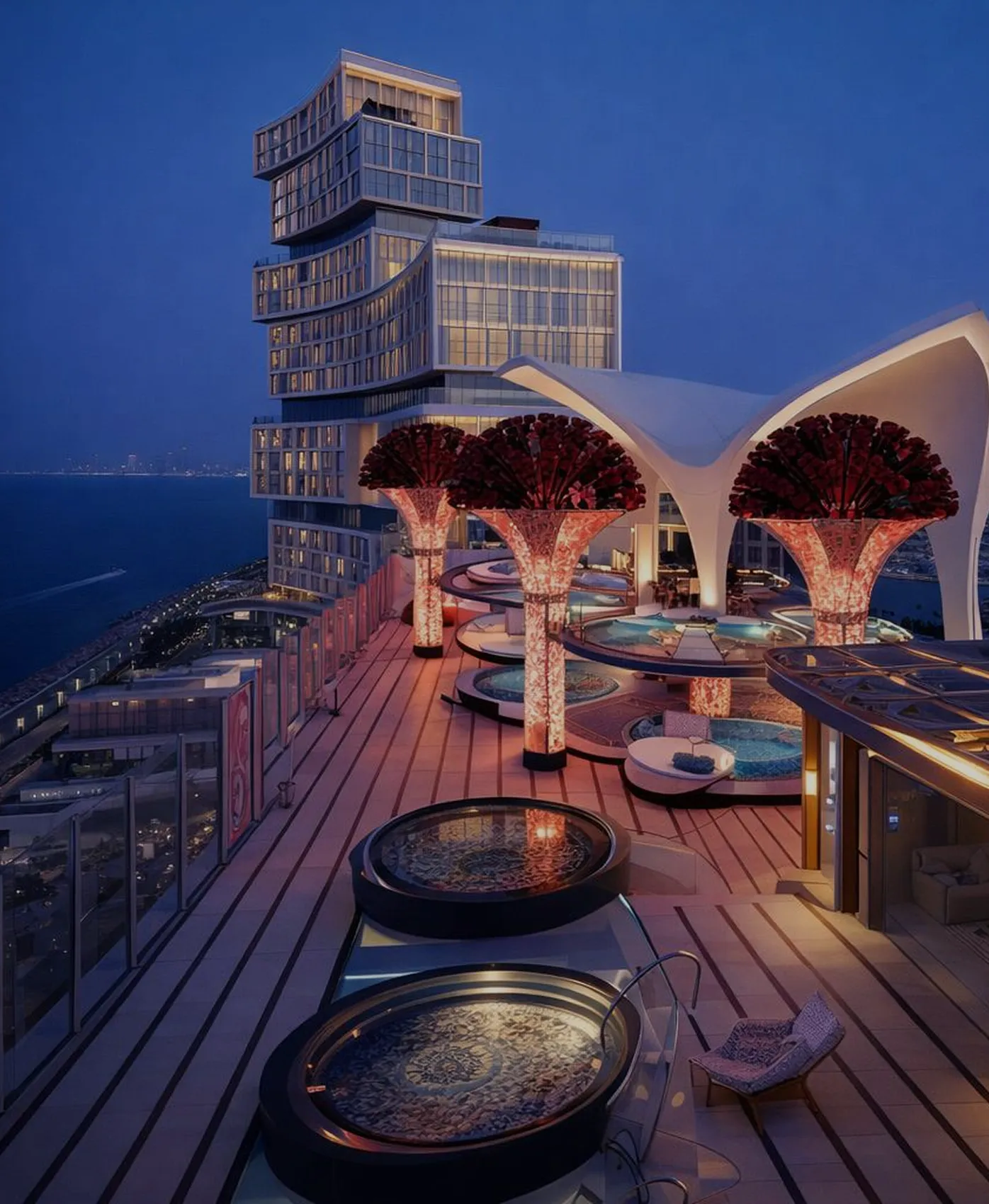
We support after handover. Reactive support, preventive maintenance, remote monitoring and performance review, with dedicated arrangements and guaranteed response times for critical installations. Our AMC client at The Royal Atlantis describes it as preventive visits on time, issues explained clearly and minimal downtime, which is the correct standard for a landmark property.
We cover both sides of the region's requirements. Multilingual control interfaces, government network and data residency constraints, and the climate and logistics realities of permanent operation here.
More than 800 delivered projects since 2018 for clients including DEWA, the Government of Dubai, Atlantis The Royal, Emaar, Dubai Future Foundation, PwC, DP World and Louis Vuitton.


Experiential technology is what the audience sees and feels — content, interaction, projection, LED, sensing. Professional AV is the engineered infrastructure underneath that distributes, processes, controls, monitors and sustains it: audio, video, signal distribution, networking, control, servers, show control and redundancy. One creates the experience, the other makes it reliable and operable.
Audio, video, signal distribution, networking, control systems, processing, media servers, monitoring, show control, redundancy and the system integration that makes them behave as one. In practice it also includes design and consultancy up front, control programming and calibration, installation and handover documentation, and ongoing support.
For a permanent environment, almost always. The immersive elements depend on signal reaching the right place at the right time, every day, operated by non-technical staff. The more synchronised systems an experience involves, the more the infrastructure determines whether it works. For a short-term event the requirement is much lighter.
AV-over-IP replaces proprietary matrix switching with standard IP networking, allowing sources, displays and control to be reconfigured in software. IPMX reached certifiable release in 2026 and tender language is shifting toward it; SMPTE ST 2110 suits broadcast-grade permanent installations; NDI is widely supported and network-friendly; SDVoE handles up to 8K; Dante and AES67 dominate networked audio. Choosing a standards-based platform materially extends the system's serviceable life.
Usually one of four causes: no monitoring, so faults are found by visitors rather than alerts; no content management architecture, so nothing can be updated; redundancy removed during value engineering; or serviceability never designed in, so maintenance quietly stops happening. All four are infrastructure decisions made long before the symptom appears.
Together, in our experience. Tendering separately means the integration risk between the two is priced twice and the gap between them is priced later as variations. It also creates a responsibility boundary that becomes the client's problem at commissioning.
Yes. Reactive support, preventive maintenance visits, remote monitoring and periodic performance review, with dedicated arrangements and guaranteed response times for critical installations. For permanent environments this should be budgeted from the outset rather than added in year two.

We design and build immersive experiences that engage, excite and transform audience interaction combining art, engineering, and next-gen technology to bring brands and spaces to life.