Services


Events & Experiences
Enterprise & Training
Gaming & Education


For thirty years, interactive installations have run on the same logic: press this, that plays. AI breaks that model. Here is what changes when a space can respond rather than replay, what is genuinely working in 2026, and the parts that are still not ready.

.png)
I want to be measured about this, because AI is currently the most over-claimed topic in our industry and I have no interest in adding to that. Much of what is promised for AI in physical spaces is not deliverable today, and some of it should not be attempted even when it is.
But the underlying shift is real, and it is structural rather than cosmetic. For the first time, an installation can respond to something nobody anticipated when it was designed. That is a genuinely different category of thing, and it is worth understanding properly, including its limits.
QUICK ANSWER: Traditional interactive installations are deterministic: every input maps to a pre-authored output defined at design time. That model is reliable and predictable, but it can only ever return content someone already made, in an order someone already decided.
Deterministic design has real virtues, and I want to defend it before describing what replaces it. It is predictable. It can be tested exhaustively before opening. It fails in understood ways. It does not say anything embarrassing to a minister. For a great many installations it remains the correct choice, and Section 8 explains when.
Its limitation is that the experience can never exceed what was authored. If a visitor arrives with a question nobody anticipated, there is no answer available, not because the information does not exist, but because nobody built a button for it. The system has no capacity to generate, only to retrieve.
The second limitation is uniformity. Every visitor receives essentially the same experience. A specialist and a schoolchild get identical content at identical depth, which means it is pitched at neither.
QUICK ANSWER: AI moves the interface from selection to conversation. Instead of choosing from options someone pre-built, a visitor can speak naturally, ask a specific question, describe what they want to explore, or receive content assembled from live information rather than a fixed library.
What a visitor can increasingly do inside a well-built AI-enabled installation:
That last point is the structural one. The experience stops being a fixed artefact and becomes something closer to a system that produces experiences.

QUICK ANSWER: The response is not limited to a screen. A well-integrated AI layer can drive voice, visual content, data displays, animation, interactive interfaces, on-screen assistants, robotics and the routing of a whole visitor journey.
The integration point matters more than any single item on that list. An AI assistant that can talk but cannot trigger the room around it is a chatbot in an expensive box. The value appears when the conversational layer is wired into show control, media playback, lighting and physical systems — so that asking a question changes the environment, not just the text on a screen.
QUICK ANSWER: The clearest way to understand the shift is this: two people can walk into the same physical space, at the same time, and leave having had genuinely different experiences — different content, depth, language and route, from the same installation.
Consider a government experience centre explaining national energy strategy.
A visiting minister asks about grid capacity under peak summer load. A fourteen-year-old on a school visit asks why the lights work when it is hot. A foreign investor asks about the regulatory framework for private generation. In a deterministic installation, all three press the same "Energy" button and watch the same four-minute film, which was written for none of them.
In a responsive installation, each receives an answer pitched at their question, in their language, at their depth, while standing in front of the same physical exhibit. The building did not change. The content did.
This is the part that genuinely excites me after two decades of watching visitors politely endure content pitched at somebody else. It is also where the discipline is required, because "personalised" is not automatically better. An experience with no fixed spine becomes formless, and a visitor who can ask anything frequently does not know what to ask. Good design in this model means a strong authored backbone with responsive depth available around it, not the abandonment of curation.
QUICK ANSWER: AI in visitor experiences has moved past pilots. Published research puts adoption at roughly a third of museum visitors in major Western markets, with most of that use happening inside the venue during the visit itself, and personalised routing and post-visit engagement now producing measurable commercial results.
Some concrete markers rather than predictions:
Adoption is no longer marginal. Research published in 2026 found roughly 32% of adult museum visitors across the UK, US, Germany and France had used museum-related AI in the previous twelve months, and that around two thirds of that use happened during the visit itself, alongside, or instead of, the interpretation the museum provided. Visitors are already doing this, whether or not the venue offers it.
Grounded answers, not open-internet answers. The deployments that work use chatbots grounded in the institution's own content, so answers about the object in front of the visitor come from the museum's scholarship rather than whatever the open web contains. This distinction is the difference between a useful tool and a liability.
Adaptive routing is live. The Museum of Science in Boston has run adaptive tours where the system notices a visitor lingering at particular exhibits and suggests related displays. First-time visitors get orientation; returning visitors get deeper material on what they previously spent time with.
Generative content as exhibit. The Museum of Modern Art's "Synesthesia" exhibition let visitors hear paintings through AI-generated soundscapes interpreting colour, brushstroke and composition, AI as the artwork rather than the guide.
Post-visit is where the commercial return shows first. Sending visitors a recap built around what they actually spent time with is reportedly converting one-time visitors into members far more effectively than generic mailing. The AI value here is not the spectacle inside the building; it is knowing what each person cared about.
Retail is moving fastest. Displays adjusting to audience, merchandising responding to live purchasing behaviour, computer vision reading footfall patterns, voice queries to in-store assistants, increasingly combined into a single live profile rather than separate systems. Analysts now expect conversational service robots in retail and hospitality settings within a two-to-three-year horizon.
QUICK ANSWER: The interesting work is not AI alone but AI joined to something physical: robotics, interactive content, real-time data, computer vision, voice, and the spatial systems that run a venue.
AI + robotics. Physical presence with natural conversation. A robot that moves is a novelty; a robot that can be asked a question and answer usefully is a host.
AI + interactive content. Content assembled or adapted at the moment of request, rather than retrieved from a fixed library. This is where content production economics change most one authored framework can serve many variants.
AI + real-time data. An exhibit that shows today's production figures, current visitor numbers or live environmental readings stops being a display and becomes an instrument. For government and utility clients this is frequently the most valuable application, and the least discussed.
AI + computer vision. Understanding not just that someone is present but what they are doing, dwelling, hesitating, moving as a family group, returning for a second time — and adapting accordingly. This is also where privacy discipline becomes non-negotiable.
AI + voice. The interface that requires no instruction. Particularly significant in this region, where multilingual delivery is a baseline requirement rather than a feature, and where voice removes the literacy and language barriers that touch interfaces impose.
AI + physical space. The integration layer: conversation wired into show control, lighting, media and environmental systems so the room itself responds. This is the hardest part and the part that determines whether any of the above feels like one experience or several gadgets in a room.
QUICK ANSWER: The application differs by objective. Museums and education gain depth-on-demand; government and tourism gain multilingual explanation at scale; retail and hospitality gain personalisation and service; corporate spaces gain the ability to tailor a visit to whoever walked in.
The common thread is that AI is most valuable where one physical space must serve genuinely different audiences. Where the audience is uniform and the message is fixed, deterministic design is still frequently the better and cheaper answer.
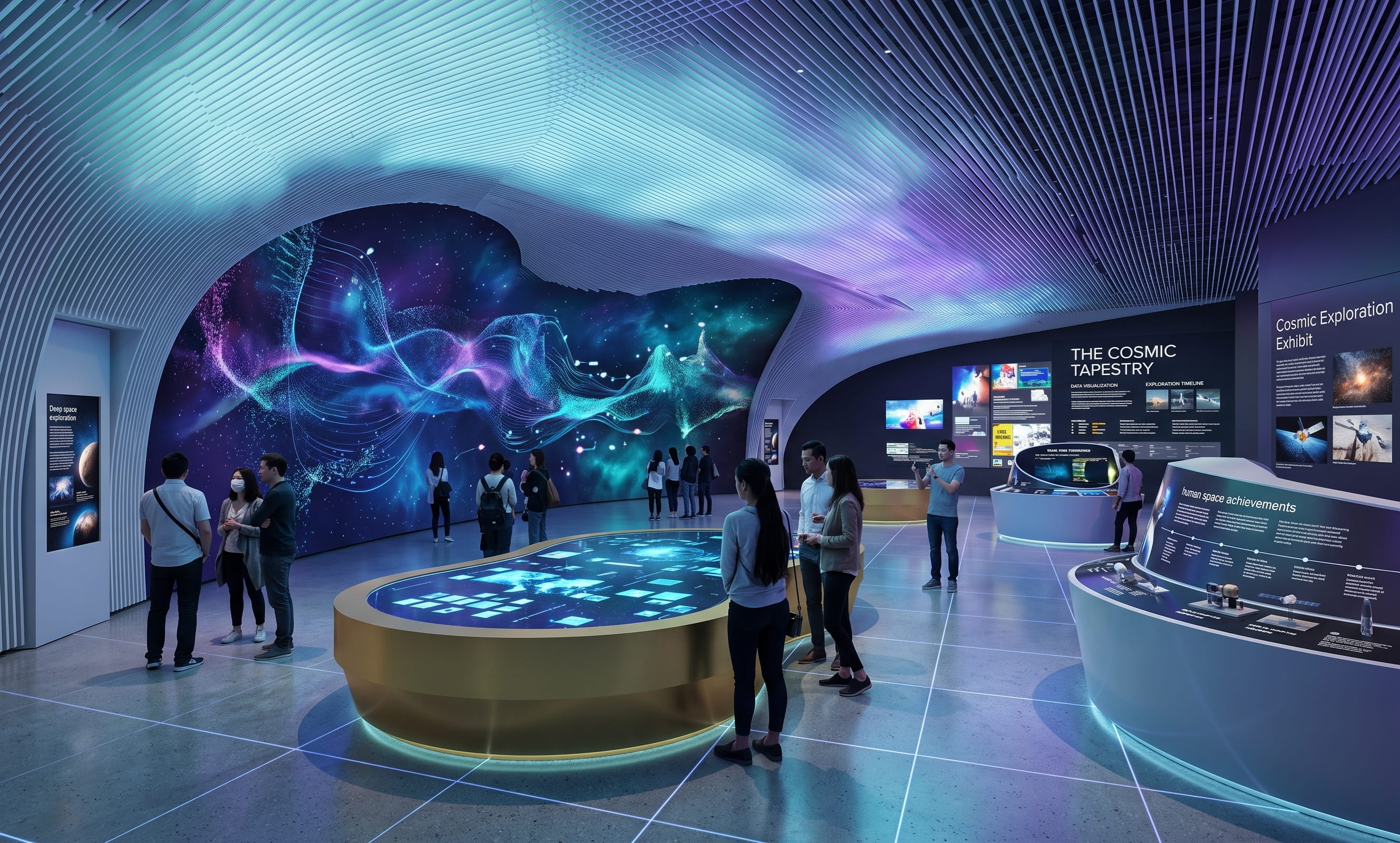
QUICK ANSWER: AI does not rescue weak content, does not remove the need for curation, introduces accuracy and latency risks that must be engineered around, and carries privacy obligations. For many installations, deterministic design remains the correct choice.
This is the section I would want to read if I were the client, so here it is plainly.
It does not rescue weak content. A generative layer over a thin proposition produces thin answers, faster. The content and the idea still have to be good.
Accuracy is an engineering requirement, not a hope. A system speaking on behalf of a government entity or a national institution cannot improvise. This is why grounding answers in the client's own approved content — and constraining what the system may say, is the central technical discipline, not an afterthought.
Latency breaks immersion. A two-second pause is fine in a chat window and fatal in a room where a visitor is waiting for the environment to respond. Response time is a design constraint that shapes the architecture.
Privacy is a design input. Computer vision that recognises returning visitors, or systems that build a profile across a visit, carry real obligations. In this region, government and semi-government projects frequently carry data residency requirements that must be designed around from the start.
It does not remove curation. Freedom to ask anything is not the same as a good experience. The strongest AI-enabled experiences have a firmly authored spine with responsive depth around it.
Sometimes deterministic is simply correct. A three-minute hero film in a dome. A kinetic sculpture. A single perfect moment designed to land identically for everyone. Adding a conversational layer to these would make them worse. We advise against it regularly.
And novelty fades here too. A talking exhibit is interesting once. What sustains it is whether the answers are genuinely useful.
QUICK ANSWER: We treat AI as an integration problem rather than a feature: the conversational layer has to be wired into show control, media, sensing and physical systems to change the room rather than just the screen. Across more than 800 delivered projects, that integration discipline is what separates a responsive space from a chatbot on a stand.
The regional context matters for anyone planning this. The UAE's National AI Strategy 2031 targets roughly 20% of non-oil GDP from AI and projects substantial additional economic growth, aligned to Centennial 2071. In Saudi Arabia, HUMAIN, under the Public Investment Fund, is building AI infrastructure at national scale, alongside SDAIA's sovereign AI work and a multi-billion-dollar national AI investment programme. Whatever one thinks of the pace, the practical consequence is that AI-enabled public and government experiences here are not speculative. The infrastructure and the political mandate are both already in place.
We build the integration, not just the interface. Conversation wired into show control, media playback, lighting, sensing and physical systems, so a question changes the environment.
We ground the content. Systems speak from the client's approved material, with constrained scope. For government and institutional clients this is the first engineering decision, not a later refinement.
We design for the region's requirements. Multilingual by default including Arabic, with data residency and network policy treated as design inputs where public-sector requirements apply.
We will tell you when not to use it. If the objective is better served by a beautifully authored fixed experience, that is the recommendation. It is a less fashionable answer and frequently the right one.
The capability is in-house. Content and app development, interactive software, AR/VR/MR, kinetic and robotic installations and Pro AV sit within one team, which is what makes wiring an AI layer into physical systems practical rather than theoretical.
More than 800 delivered projects since 2018 across the UAE, Saudi Arabia, Oman and the wider GCC, for clients including DEWA, the Government of Dubai, Dubai Future Foundation, Atlantis The Royal, Emaar and PwC.


Most current deployments fall into four groups: conversational guides grounded in the museum's own scholarship that answer questions about the object in front of a visitor; adaptive routing that suggests exhibits based on dwell and interest; generative content used as artwork in its own right; and post-visit engagement built around what each visitor actually spent time with. Research published in 2026 found roughly a third of adult visitors in major Western markets had used museum-related AI in the previous year.
A traditional interactive is deterministic, every input maps to content authored in advance, so every visitor walks the same branches. An AI-enabled installation can respond to inputs nobody anticipated, adjust depth and language, and assemble answers from live sources. The trade-off is that deterministic systems are exhaustively testable, while responsive systems must be engineered for accuracy and constrained in scope.
Yes, and that is the core shift. Content, depth, language and route can all vary by visitor while the physical exhibit stays the same a minister, a school student and an investor can each get an answer pitched to their question in front of the same display.
No. Where the audience is uniform and the message is fixed a hero film, a kinetic sculpture, a single designed moment meant to land identically for everyone deterministic design is usually better and cheaper. AI earns its place where one space must genuinely serve different audiences.
By grounding it in the client's approved content rather than the open internet, and by constraining what it is permitted to discuss. For government and institutional clients this is the primary engineering requirement, addressed at architecture stage rather than tested for afterwards.
Any system using computer vision or building a profile across a visit carries real obligations around consent, storage and accountability. In this region, public-sector projects frequently add data residency requirements. These are design inputs that shape the architecture, not compliance paperwork added at the end.
Not usually upfront. It can materially reduce the cost of keeping an experience current, because one authored framework can serve many variants and content can draw on live data rather than requiring re-production. The saving appears over the life of the installation rather than at build.
The UAE's National AI Strategy 2031 targets around 20% of non-oil GDP from AI, and Saudi Arabia is building AI infrastructure at national scale through HUMAIN and SDAIA. Practically, that means AI-enabled government, cultural and tourism experiences in this region have both political mandate and infrastructure behind them, which is not the case in every market.


.png)
We design and build immersive experiences that engage, excite and transform audience interaction combining art, engineering, and next-gen technology to bring brands and spaces to life.