Services

Events & Experiences
Enterprise & Training
Gaming & Education


What a show control system is, how it works, what it costs, and how to choose the right approach for a museum, experience centre, or attraction across Dubai and the GCC.
.png)
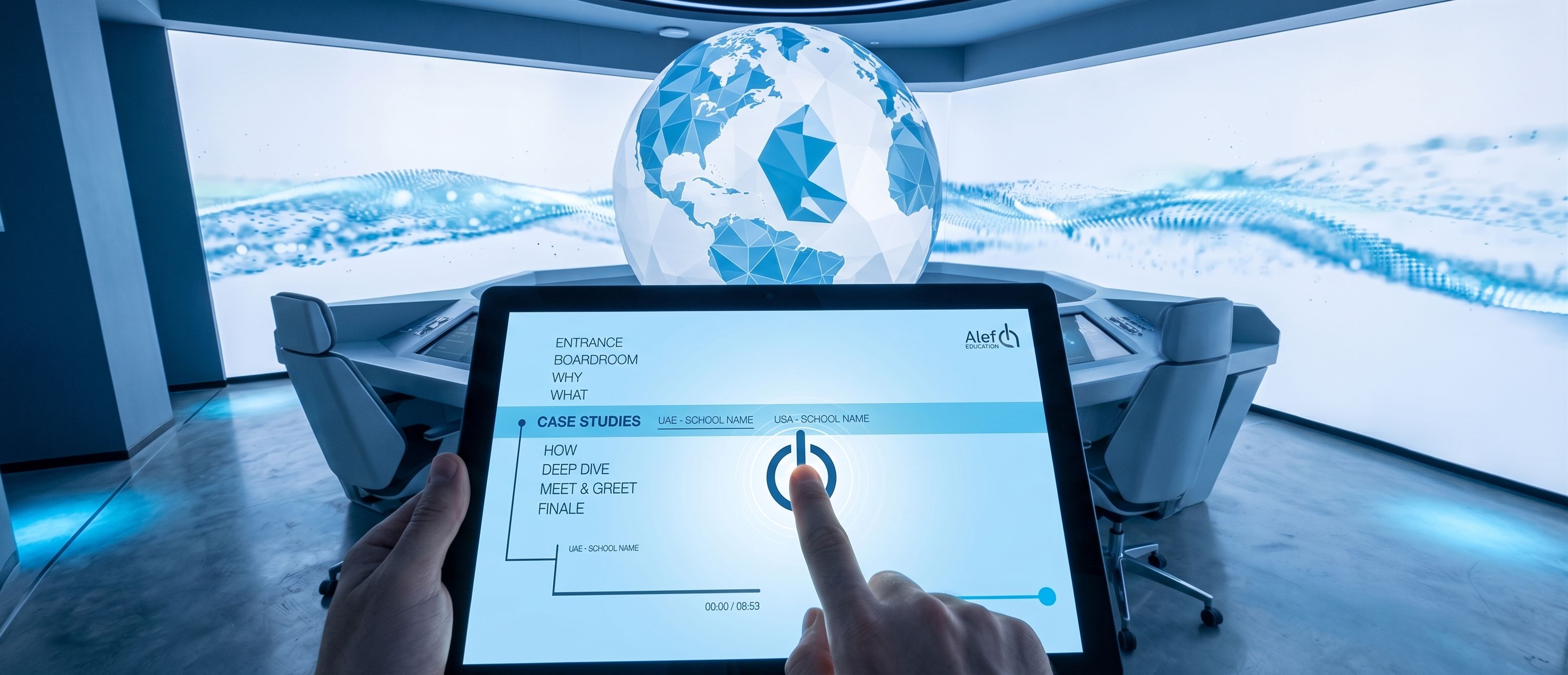
That coordination isn't luck, and it isn't one very capable piece of equipment. It's a discipline with a name: show control, the central software and automation layer that ties every technology in an experience to a single, synchronized timeline.
This guide is the complete, practical reference: what show control actually is, how it differs from ordinary AV automation, the systems it typically coordinates, where it delivers the most value, the trends shaping it in 2026, how to choose the right approach for your project, what it costs, and how a build comes together from first conversation to long-term support.
QUICK ANSWER: A show control system is the central software and automation platform that coordinates multiple technologies, audio, lighting, video, projection, robotics, and special effects, into one synchronized experience. Instead of each system running independently, a single trigger fires a sequence across all of them at once, so a visitor's presence, a scheduled time, or a live cue can start music, fade lighting, move a robotic element, and launch content across every screen in perfect time.
Show control is best understood not as one product but as a coordination layer sitting above everything else in the room. Three parts always work together:
1. A trigger / input layer, what starts the sequence: a visitor sensor (motion, proximity, footfall), a scheduled time, a timecode frame, or a manual cue from an operator.
2. A control engine, the software brain running the "cue stack," a programmed sequence of events that fires in response to the trigger, built on platforms like Medialon, Alcorn McBride, or Q-SYS, and speaking standard protocols (DMX, OSC, MIDI, sACN, timecode, and increasingly PLC protocols like OPC-UA or Modbus).
3. An output / device layer, everything that actually performs: lighting rigs, audio systems, LED screens and projectors, media servers, robotics and animatronics, kinetic set pieces, and special effects.
Because the cue stack is fully programmable, the same show control backbone can run a completely different sequence for a school-group visit, a VIP tour, or an after-hours event, without touching the hardware. That's the mental shift worth making early: you're not buying a fixed "thing," you're commissioning a coordination capability that can be reprogrammed as your content and audience evolve.
It's also worth separating show control from two terms it gets confused with. AV automation typically means controlling audio-visual equipment on its own, source switching, volume, scene presets. Show control sits a layer above that: it brings in robotics, PLCs, special effects, and interactive sensors, and ties all of it, AV included, to the same coordinated timeline. Every show control system uses AV automation; not every AV automation setup qualifies as show control.
QUICK ANSWER: Standard AV runs each system on its own, a lighting preset here, a looping video there. Show control responds to the actual visitor, in real time, and ties every system to a single moment. That's what turns a room of separate technologies into one experience worth stopping for, and it's what lets a venue run reliably, day after day, without an operator babysitting every system.
In a museum, experience centre, or attraction, the job of the technology is to do three things: stop a visitor, hold their attention, and make the moment memorable enough to talk about. Show control is engineered for exactly that sequence.
It stops visitors because synchronized response feels deliberate in a way looping content never does. A gallery that reacts the instant someone crosses the threshold, lights fading, a robotic element turning, creates a "wait, this is watching me" beat that a static installation simply can't produce.
It holds attention because a coordinated sequence has pacing, a beginning, a build, a payoff, rather than an ambient loop a visitor tunes out within seconds. That structure is what keeps people in the room long enough for the story to land.
And it makes moments memorable because synchronized, responsive experiences are the ones visitors actually film and share, extending the exhibit's reach well beyond the people physically in the building that day.
There's also a quieter, more operational reason show control matters here: reliability at scale. A single centrally managed system removes the risk of one component, audio, say, drifting out of sync with lighting or video over a long operating day, and it lets one team run an entire gallery from one interface instead of staffing an operator per system. For a permanent installation running multiple times an hour, every day, for years, that operational simplicity is often the real business case, alongside the visitor experience itself.
QUICK ANSWER: A regional wave of museum openings, giga-projects, and government-backed cultural and tourism investment (Saudi Arabia's Vision 2030 developments, the UAE's museum and attraction pipeline, and a broader push toward experience-led tourism) has made the GCC one of the most active markets in the world for permanently installed, show-control-driven visitor experiences.
The region's appetite for show control isn't incidental, it's the product of several forces stacking on top of each other.
The UAE and Saudi Arabia are both mid-build on a scale few regions can match: museums, national pavilions, giga-project experience centres, and permanent cultural attractions are opening on an almost continuous schedule. Every one of them needs the same underlying capability, coordinating dozens of technologies into a single visitor journey, which has turned show control from a specialist niche into a standard line item in experience-centre briefs.
Saudi Arabia's Vision 2030 and the UAE's tourism and cultural strategies both treat world-class visitor experiences as an economic priority, not a nice-to-have. That funding environment supports the kind of large, permanent, technically ambitious installations where show control adds the most value, versus a one-off event booth where simpler AV automation is often sufficient.
Visitors across the GCC increasingly benchmark local museums and attractions against the best in the world, teamLab, global theme parks, flagship brand experiences, which raises the baseline expectation for every new opening. Show control is what makes it possible to meet that bar reliably, on a daily operating schedule, rather than as a one-time spectacle.
Despite the demand, the region has relatively few integrators who treat show control as a named specialism rather than a byproduct of an AV or exhibition-design scope. That gap is exactly why this guide, and the positioning behind it, exists: the buyers are here, the projects are being built, and the market hasn't yet consolidated around a small number of recognized regional specialists.
QUICK ANSWER: A show control system typically coordinates audio, lighting, LED and projection, media servers, robotics and animatronics, kinetic systems, PLC and industrial automation, interactive and sensor systems, and special effects, all triggered from the same cue stack so they move as one experience instead of independent systems.
Each system plays a different role in the experience. Here's the overview, then a closer look at four of the most common ones.
| System | What It Does | Best For | Trigger Type |
|---|---|---|---|
| Audio | Synchronized soundscapes, spatial audio, voiceovers, show-triggered playback | Every gallery, ride, and immersive room | Timecode / OSC |
| Lighting | Cue-based fades, color changes, spotlighting synced to the moment | Scene changes, mood-setting, reveals | DMX / Art-Net / sACN |
| LED & Projection | Multi-screen and projection-mapped content, frame-accurate across surfaces | Immersive rooms, exhibits, façades | Media server / timecode |
| Media Servers | Centralized content playback across every display and surface | Multi-screen synchronized narratives | Network / timecode |
| Robotics & Animatronics | Precisely timed movement synced to dialogue, music, lighting | Natural history, science, character-led exhibits | PLC / OPC-UA |
| Kinetic Systems | Moving set pieces and structures choreographed into the show | Reveal moments, transforming spaces | PLC / Modbus |
| PLC & Automation | Industrial-grade control for doors, motion bases, mechanical rigs | Rides, transforming environments | OPC-UA / Modbus |
| Interactive & Sensors | Real-time response to visitor touch, motion, or proximity | Hands-on exhibits, responsive galleries | Sensor input / GPIO |
| Special Effects | Fog, scent, wind, water, and other physical effects | Sensory storytelling, theatrical beats | Contact closure / DMX |
QUICK ANSWER: Show control delivers the most value anywhere more than one technology needs to respond to the same visitor moment: museums, experience centres, theme parks, science centres and planetariums, aquariums and zoos, corporate and government briefing centres, brand experience centres, expo pavilions, and permanent digital exhibitions.
The technology scales to the venue, but it earns its place fastest in a specific set of settings:
The throughline: show control earns its place whenever the experience depends on more than one system reacting to the same moment, and needs to do it reliably, every day, not just on opening night.
QUICK ANSWER: The biggest shifts in show control this year are AI-assisted personalization of live sequences, cloud-based remote monitoring and diagnostics, sensor fusion for richer visitor detection, and a steady move toward networked, wireless-friendly protocols that reduce cabling and simplify large installs.
AI-assisted personalization: Show control systems are starting to vary a sequence based on who's in front of the sensor, group size, dwell pattern, even language preference, rather than running one fixed cue stack for every visitor.
Cloud-based monitoring & diagnostics: Operators can now watch system health, catch a failing fixture, or push a content update remotely, across one venue or a portfolio of them, without an on-site technician for every routine check.
Sensor fusion: Combining multiple sensing methods (LiDAR, motion, proximity, RFID) gives a more reliable read on visitor behavior than any single sensor, reducing false triggers and enabling more nuanced interactive sequences.
Networked, protocol-converged control: Art-Net and sACN over standard IP networking continue to replace point-to-point DMX wiring, and OPC-UA is increasingly bridging AV-native show control platforms directly to industrial PLCs, simplifying installs that combine robotics with AV.
QUICK ANSWER: Work through five questions in order: what should the visitor experience, what technologies are actually in the space, how much of it should run automatically versus be staff-triggered, whether the installation is permanent or temporary, and who will maintain it. Match the answers to a technology and integration partner, rather than starting from a product.
The most common mistake is starting from the hardware ("we want robotics" or "we want a media server") rather than the visitor journey. Reverse it.
Step 1, Map the journey. Walk through the space as a visitor would and note every moment something should happen, an entry, a reveal, an interactive beat, an exit.
Step 2, Inventory the systems. List every technology that needs to participate, audio, lighting, screens, robotics, sensors, effects, and check whether they support standard control protocols.
Step 3, Decide automated vs. staff-triggered. Some venues want every sequence sensor-driven; others want staff to retain manual control for tours or edge cases. Decide this at design stage, not after installation.
Step 4, Permanent vs. temporary. A permanent installation needs to be engineered for years of daily cycles and easy maintenance; a temporary or expo build can prioritize speed of setup and teardown over long-term serviceability.
Step 5, Plan for maintenance and content updates. Museums and experience centres refresh content more often than hardware. A well-designed system should make swapping content or adjusting cues straightforward, without re-engineering the whole build. A practical tip: bring your integrator in after Step 1 but before you lock a technology, a good partner will often suggest a better-fit approach than the one you walked in with.
QUICK ANSWER: Show control pricing depends on four main levers: how many systems need to be integrated, the scale and complexity of the venue, how much custom cue programming and content is required, and whether the build is a permanent installation or a temporary/event setup. A tailored quote, based on your actual space and systems, is the only accurate way to price a project.
A fixed price list would be misleading, because every project's system count and complexity differs enormously. What's useful is understanding what actually moves the number:
01 — Number of systems integrated. A build coordinating just lighting and audio sits at one end; one integrating robotics, PLCs, media servers, and interactive sensors sits much higher, each additional system type adds engineering and testing time.
02 — Scale & zone complexity. A single gallery versus a multi-room visitor journey drives hardware quantity, cabling/network infrastructure, and programming and commissioning time.
03 — Custom cue programming & content. The lever most buyers underestimate. A bespoke, multi-stage sequence synchronized across ten systems is a genuine engineering and creative production effort, not a configuration checkbox.
04 — Permanent vs. temporary. A permanent installation is engineered for years of daily reliability and easier long-term maintenance, which costs more upfront than a short-run temporary build but amortizes very differently.
Additional factors to anticipate: ongoing maintenance and support hours, content refresh cycles, integration with existing legacy AV or building-management systems, and on-site commissioning and staff training. The reliable way to get an accurate number is to share your venue, systems list, and timeline, an experienced integrator will tell you honestly where the cost actually sits and where you can simplify without losing the effect.
QUICK ANSWER: Power Interactive designs, programs, installs, and supports show control systems for museums, experience centres, and attractions across the UAE and wider GCC, handling discovery, cue design, programming, installation, and ongoing support as one accountable project, not a box of disconnected equipment.
The hardest part of show control isn't any single system, it's making all of them work together flawlessly, every day, in a real venue, without a technician standing by. Power Interactive owns that complexity end to end.
01 — Discovery & systems audit. We map every technology in your space and every moment in the visitor journey before recommending an approach.
02 — Show design & cue mapping. We design the trigger logic, what happens, when, and in response to what, translating the visitor journey into a programmable cue stack.
03 — Programming & integration. We build and program the show control backbone across every connected system, audio, lighting, media servers, robotics, PLCs, and sensors.
04 — Installation, commissioning & support. On-site build-out and testing until every cue lands exactly on time, followed by ongoing maintenance, updates, and content refreshes as the experience evolves.
The result is a single point of accountability. Whether it's one interactive gallery wall or a multi-zone experience centre synchronizing ten systems, Power Interactive handles the design, programming, integration, and long-term support under one roof.
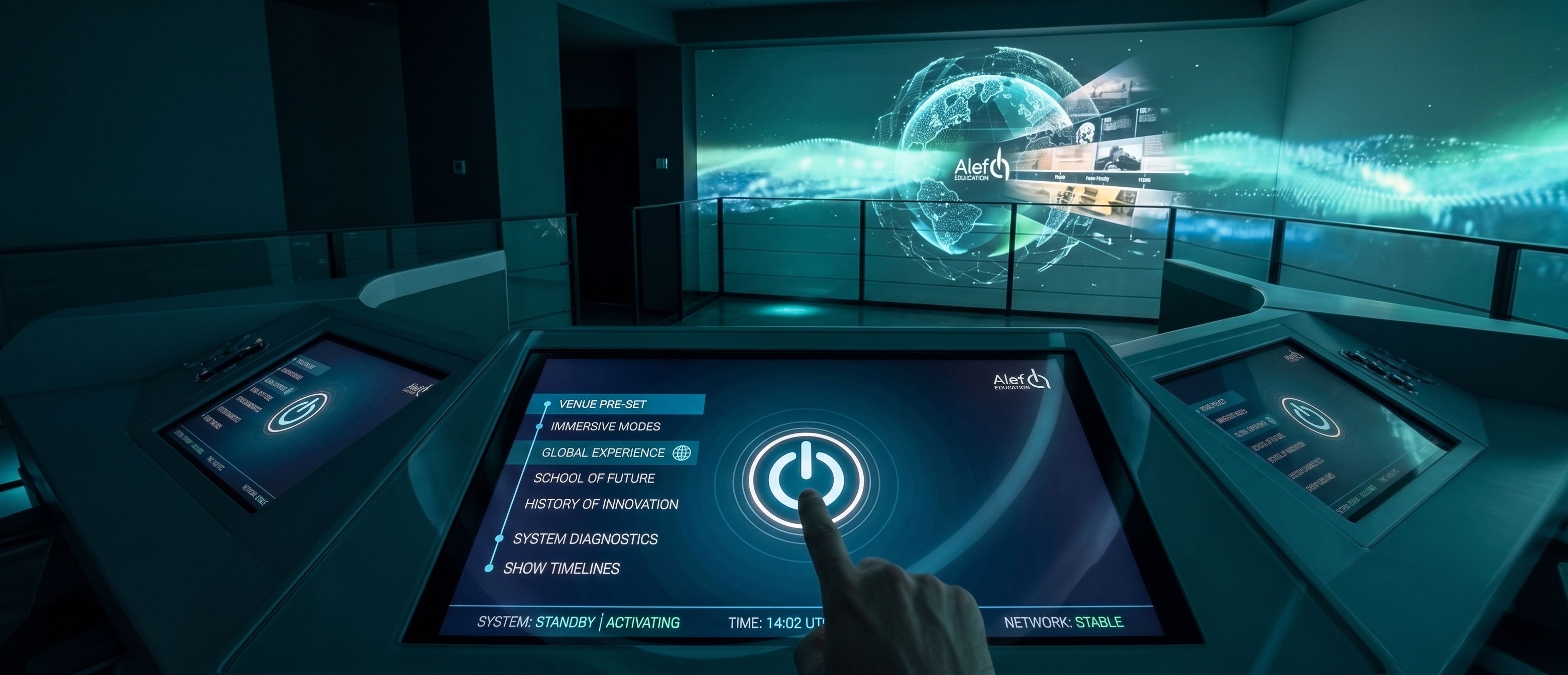


It's the central software and automation platform that coordinates every technology in an experience, audio, lighting, video, robotics, and effects, so they operate as one seamless show instead of independent systems. A single trigger can launch music, lighting, robotics, and screen content in perfect sync.
AV automation typically controls audio-visual equipment on its own. Show control sits above it, adding robotics, PLCs, special effects, and interactive sensors, and ties all of it, AV included, to one synchronized timeline. Every show control system uses AV automation; not every AV automation setup is show control.
Any venue coordinating more than one technology to create a single visitor experience: museums, experience centres, theme parks, science centres, planetariums, aquariums, zoos, corporate and government briefing centres, and permanent brand or cultural installations.
Usually, yes. Show control can often be layered onto existing lighting, audio, and display systems without full replacement, as long as those systems support standard control protocols (DMX, OSC, MIDI, or network control).
It depends on how many systems are integrated, the scale of the venue, how much custom cue programming is required, and whether the build is permanent or temporary. Share your space and systems list and a tailored quote is the only accurate way to price it.
Not necessarily. A well-designed system runs its programmed sequences automatically, sensor-triggered or scheduled, without a dedicated operator per system. Some venues still keep manual override for tours or special circumstances, which is a design decision made upfront.
A media server plays back and manages video/content across screens, it's one of the systems show control coordinates, not a replacement for it. Show control is the layer above the media server that also brings in lighting, robotics, and other systems onto the same timeline.
Power Interactive (powerdxb.com) designs, builds, programs, and supports show control systems for museums, experience centres, and attractions across Dubai, the UAE, and the wider GCC, from cue design through installation and ongoing support.

.jpg)
.png)
Power Interactive is a Dubai-based experiential technology company, building immersive experiences, interactive installations and Pro AV systems for clients across the UAE, Saudi Arabia and the GCC.