Services

Events & Experiences
Enterprise & Training
Gaming & Education


Most technology companies supply what already exists. Some of the most interesting projects begin when a client says the thing they need has not been built. This is the actual development process, the three gates where projects fail, what changes cost once tooling is cut, and when you should buy off the shelf instead.

.jpg)
That question separates two quite different businesses. Supplying and integrating existing products is one discipline, a legitimate and demanding one, and most of what this industry does. Developing something that has never been manufactured is another, requiring industrial design, mechanical engineering, electronics, firmware, software, prototyping and a manufacturing route.
This article is about the second. It is deliberately unromantic, because custom development is frequently sold as creative adventure and is actually a sequence of engineering gates with real costs attached. Understanding those gates is what lets a client decide whether to walk through them.
QUICK ANSWER: System integration assembles existing products into a working whole. Product development creates something that does not yet exist, through design, engineering, prototyping and manufacture. The first is constrained by what the market sells; the second is constrained by physics, budget and time.
The distinction matters because the two are priced, scheduled and risked completely differently.
An integration project has known quantities. The projector has a specification sheet. The sensor has a documented latency. The risk sits in how they combine, and experienced integrators manage that risk well.
A development project has unknowns by definition. Nobody can hand you a datasheet for the thing that does not exist. The first question is not "how much" but "is this possible, and how would we find out cheaply?" That is a different conversation, and any supplier who quotes a firm price for a genuinely novel mechanism before feasibility work is either guessing or building in an enormous contingency.
The payoff is that a developed product is yours. It does not appear on a competitor's stand next season, because it cannot be bought.
QUICK ANSWER: Idea, feasibility, concept design, industrial design, mechanical engineering, electronics, software development, prototype, testing, refinement, fabrication, production, deployment. Each stage exists to reduce uncertainty before the next stage spends more money.
Three groupings are worth understanding as a client:
Stages 1–2 are cheap and decisive. Feasibility work costs a fraction of the project and determines whether the rest should happen. Clients frequently want to skip it. It is the single worst economy available in this process.
Stages 3–7 run in parallel, not sequence. Industrial design, mechanical, electronics and software are developed together and constantly constrain one another. A form decision changes the mechanism; the mechanism changes the board layout; the board changes the thermal design. Managing that concurrency is most of the craft.
Stages 8–10 are where the truth arrives. A prototype either works or it does not, and everything before it was an informed prediction.
QUICK ANSWER: For a custom hardware product, expect roughly 16–18 months from idea to market. Concept design takes 1–3 months, prototyping 6 months or more, and moving from a mature working prototype to volume production typically takes a further 4–12 months.
Published industry benchmarks, which match our own experience closely:
One-off installation pieces are faster than products intended for manufacture, because tooling and certification for volume are not required. But the honest planning position for anything genuinely new is that it takes longer than clients expect, and the compression usually comes out of testing, which is exactly the wrong place to take it from.
.png)
QUICK ANSWER: Feasibility, design for manufacture, and validation testing. Each is a deliberate checkpoint, and skipping any of them moves the failure later, where it is far more expensive.
Gate 1: Feasibility. Can the mechanism deliver the required motion, force, precision and duty cycle within the space, budget and power available? This should be answered with quick tests and calculations before anyone produces beautiful renders. Projects that skip feasibility often reach prototype stage before discovering the physics does not cooperate.
Gate 2: Design for manufacture. DFM should begin before final design files are released, not after. Identifying manufacturability problems while the design is still fluid reduces redesign, cost and lead time. Discovering them afterwards means reopening finished work.
Gate 3: Validation testing. Function, durability under real use, safety, and behaviour with actual users. Public-facing installations get handled far more roughly than designers imagine, an interaction rated for a thousand cycles will see that in a fortnight at a busy museum.
QUICK ANSWER: A design change after production tooling is cut costs roughly USD 15,000–150,000 before any launch delay is counted. The same change during design costs essentially nothing. This asymmetry is why the early stages exist.
This is the single most useful number in this article, and it explains every piece of process discipline above.
Changing a dimension in CAD during design costs an engineer's afternoon. Changing the same dimension after a production tool has been machined means modifying or replacing that tool, published figures put this at USD 15,000 to 150,000, before the commercial cost of a delayed launch is added.
The consequence for how you should run a project:
Decide the difficult things early, while they are cheap. Size, mounting, interaction model, material, serviceability. These feel premature at concept stage and are ruinous to revisit after tooling.
Pay for prototypes, plural. A prototype that reveals a problem has paid for itself several times over. Clients sometimes view a failed prototype as wasted budget; it is the opposite, it is the cheapest possible place to fail.
Freeze the design before tooling, genuinely. A design freeze that everyone treats as provisional is not a freeze, and the cost of that ambiguity lands later.
QUICK ANSWER: Scaling from a single working unit to a fleet introduces manufacturing consistency, certification, spares strategy, installation standardisation and remote monitoring, a different set of problems from building the first one.
For a single hero installation, development ends at deployment. For a retail rollout, a branded activation touring multiple cities, or a fleet of interactive exhibits across a destination, that is the halfway point.
What changes at volume:
Consistency becomes the specification. Unit 40 must behave identically to unit 1. That means production tolerances, quality control and assembly documentation rather than skilled improvisation.
Certification becomes mandatory. Marks and approvals that a one-off may not require become gating items for a product deployed across territories.
Spares and serviceability become a system. Which components fail, how often, who holds stock, and how quickly a unit can be restored in a city with no technician.
Installation must be repeatable. A build that depends on the original engineering team cannot scale. It has to be installable from documentation by a competent local crew.
Remote monitoring stops being optional. With forty units in twelve locations, you cannot discover faults by visiting. Fleet health monitoring is the only practical operating model.
QUICK ANSWER: It is justified when the outcome cannot be achieved with existing products, when the thing itself must be ownable and unrepeatable, or when it will be deployed at enough scale that a bespoke unit cost beats an adapted off-the-shelf one.
For context on the kinetic and robotic end of this range, published market figures put custom installations at roughly USD 15,000 for a small retail piece to USD 500,000 and above for a large museum-scale work, driven mainly by mechanism count, custom control software complexity and installation labour.
QUICK ANSWER: If an existing product achieves the objective, buy it. Custom development is justified by necessity or scale, not by novelty. We turn down development briefs regularly for exactly this reason.
A section that costs us work, and belongs here anyway.
If something on the market does the job, use it. You will get it faster, cheaper, supported, and with spares available. "Nobody else will have it" is rarely worth a twelve-month programme on its own.
If the timeline cannot accommodate proper development, do not start. Compressed development means compressed testing, and compressed testing means failures in public. For a fixed, immovable opening date with insufficient runway, adapting existing technology is the responsible answer.
If the budget covers development but not iteration, reconsider. A project funded for exactly one prototype has no room to respond to what that prototype teaches, which is the entire point of building it.
If nobody on the client side can own it long-term. Custom hardware needs someone accountable for spares, updates and support. Without that, a bespoke unit becomes an orphan.
QUICK ANSWER: We run industrial design, mechanical engineering, electronics, software and fabrication in-house alongside our integration and AV capability, which is why we can take a brief from feasibility through prototype to production and deployment rather than handing it between vendors.
Most of our work is integration and delivery. But a meaningful share begins with a client describing something that does not exist, and we have built the capability to say yes to that honestly rather than adapting something and hoping.
We start with feasibility, and we will tell you if the answer is no. A short, inexpensive feasibility phase before design commitment. Occasionally the outcome is that the idea does not work as imagined, which is a considerably better thing to learn in month one than month nine.
The disciplines sit together. Industrial design, mechanical engineering, electronics, software and content development in one team, which is what makes the concurrent stages in Section 2 manageable rather than a coordination exercise between suppliers.
We build prototypes to be broken. Testing is designed to find the failure mode before the public does, particularly for anything with motion in a space where people will handle it.
We can take it to volume. For rollouts and multi-site deployments, production, quality control, installation documentation and fleet monitoring are part of the same engagement.
We stay for deployment. Installation, commissioning, operator training and support, because a product that nobody on site can run has not been delivered.
More than 800 delivered projects since 2018 across the UAE, Saudi Arabia, Oman and the wider GCC, including kinetic and robotic installations, for clients including DEWA, the Government of Dubai, Atlantis The Royal, Emaar, Dubai Future Foundation, DP World, Adidas and Louis Vuitton.


For a hardware product, roughly 16–18 months from idea to market: 1–3 months concept design, 6 months or more to a validated prototype, and a further 6–12 months from working prototype to volume production through DFM, tooling, pilot runs and certification. A one-off installation piece is faster, because tooling and volume certification are not required.
Thirteen stages: idea, feasibility, concept design, industrial design, mechanical engineering, electronics, software development, prototype, testing, refinement, fabrication, production and deployment. Industrial design, mechanical, electronics and software run concurrently rather than in sequence, constantly constraining one another.
Because it is the cheapest place to discover that something will not work. Feasibility costs a small fraction of a development programme and answers whether the mechanism can deliver the required motion, force, precision and duty cycle within the available space, power and budget. Skipping it moves that discovery to prototype stage, at many times the cost.
A design change after production tooling has been cut runs roughly USD 15,000–150,000 before any launch delay is counted. The same change during the design phase costs an engineer's time. That asymmetry is the entire argument for deciding difficult things early and genuinely freezing the design before tooling.
DFM is adapting a design so it can actually be manufactured consistently and economically. It should begin before final design files are released, while the design is still fluid — identifying manufacturability problems during design reduces redesign, cost and lead time, whereas finding them afterwards means reopening completed work.
Yes, though it introduces a different problem set: manufacturing consistency so unit 40 matches unit 1, certification for the territories involved, a spares and serviceability strategy, installation documentation so local crews can build it without the original team, and remote fleet monitoring.
Published market figures span roughly USD 15,000 for a small retail piece to USD 500,000 and above for large museum-scale work. The main drivers are the number of moving mechanisms, the complexity of the custom control software, and installation labour.
When an existing product achieves the objective, when the timeline cannot accommodate proper testing, when the budget covers a single prototype with no room to iterate, or when nobody on the client side can own the product long-term. Novelty alone is not a sufficient reason.

.png)
.png)
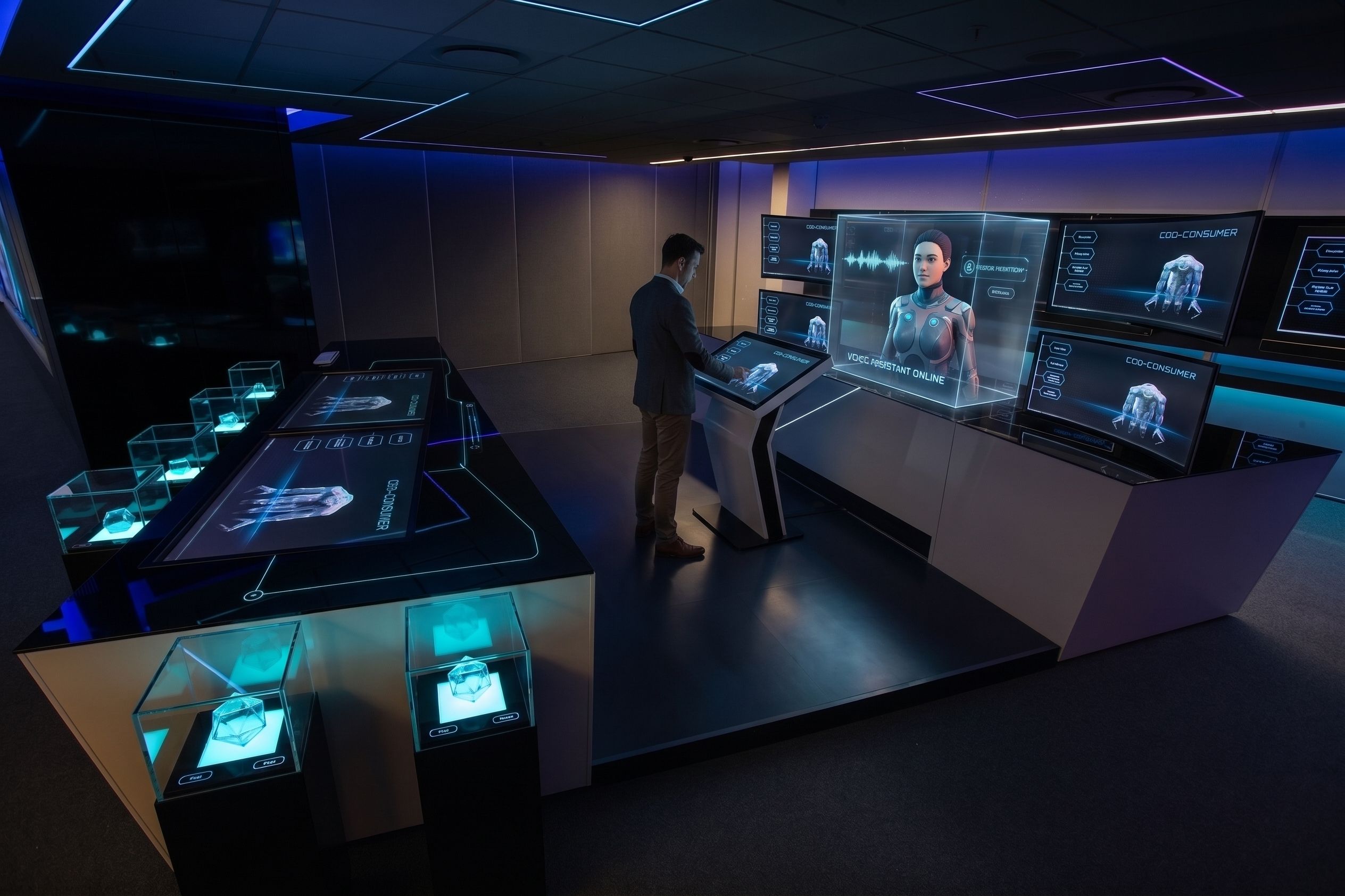
We design and build immersive experiences that engage, excite and transform audience interaction combining art, engineering, and next-gen technology to bring brands and spaces to life.