VR Simulators for Events, Exhibitions & Entertainment Venues

Racing, flight and full-motion VR simulators that put your audience in the driver's seat, the cockpit or the open sky. We supply the rigs, build the content, handle the integration and run them on the day — for a three-day exhibition or a permanent attraction, anywhere in the GCC.

Request a quote

What is a VR Simulator?

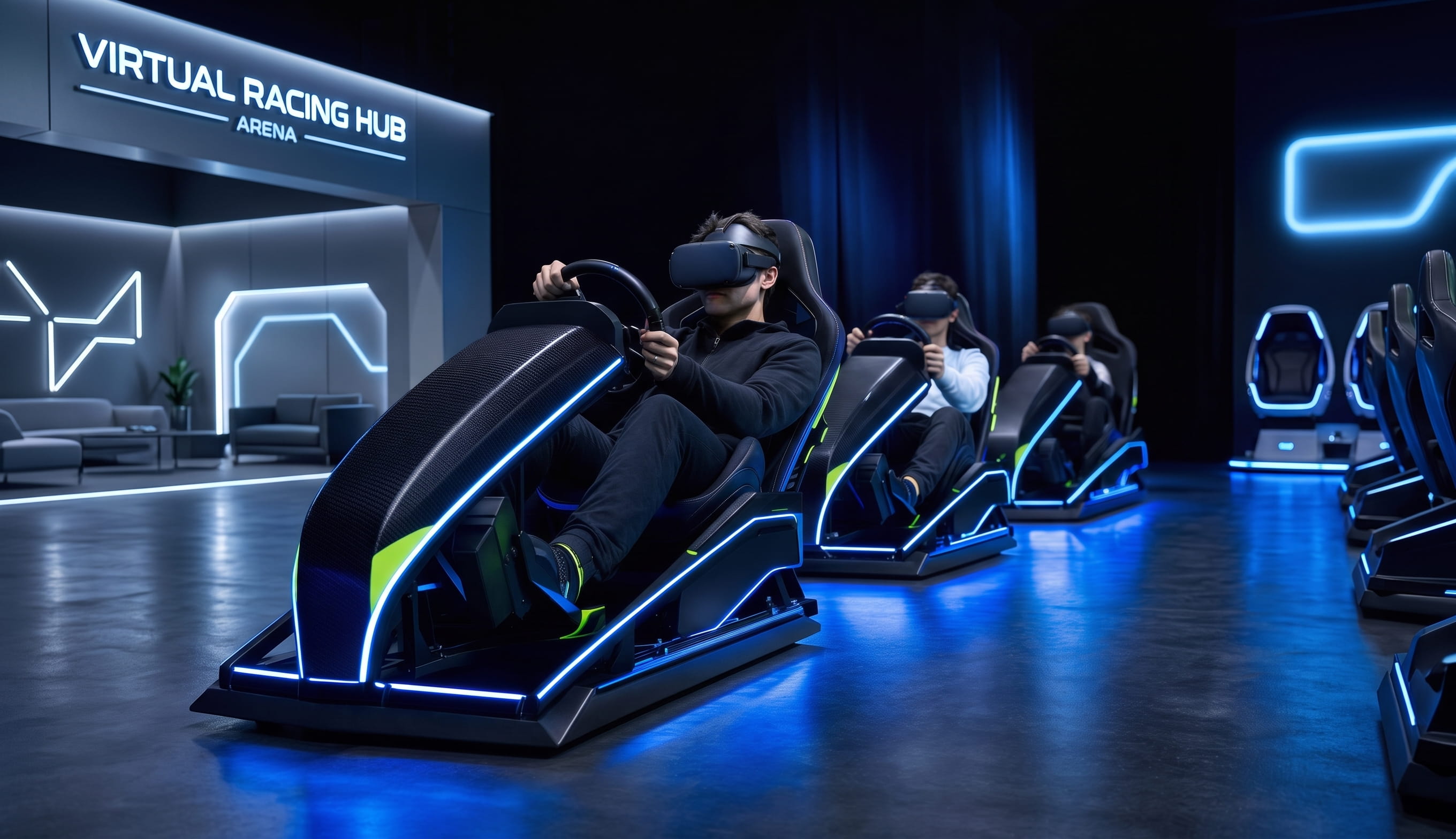
A VR simulator pairs a motion platform with a virtual reality headset and a physics engine, so that when the rider turns, banks, accelerates or brakes in the virtual world, the rig physically moves to match. A VR racing simulator pitches and rolls through corners and kerbs. A VR flight simulator banks and dives. The rider is not watching an experience, they are inside one, and their body agrees with their eyes.

That last part is the whole point, and it is also the part most people get wrong about VR. Adding physical motion does not make simulators more nauseating. It makes them less nauseating. The full explanation is in the FAQ below, and it is the single most useful thing we can tell you before you book one.

For a venue, a VR simulator is a repeat-visit attraction: people queue, ride, and get straight back in line to beat their time. For an exhibition stand, it is the thing that stops the aisle and gives your team a captive, positive two minutes with a qualified visitor. For a mall, it is a ticketed attraction that lifts footfall and dwell time in a space that was previously just circulation.

Key Features

VR Racing Simulator

A seated cockpit with a force-feedback wheel, pedals and a motion base that moves through every corner, kerb and impact. The highest-throughput option and the easiest sell to a broad audience, almost everyone understands driving. Leaderboards and head-to-head racing turn it into a competition your audience will queue twice for.

VR Flight Simulator

A cockpit-style rig with flight controls and a motion base, flying jets, light aircraft or free-flight environments. Strong for aviation, aerospace, travel and tourism brands, and for anyone who wants a premium, slower-paced ride.

VR Hand Glider

A harnessed glider rig where riders lean and steer with their whole body to soar through open landscapes. The most physically expressive of the rigs and the most photographed — the rider silhouette makes a better photo than a seated cockpit, which matters for social reach. Full detail on our VR hand glider page.

VR Motion Chair & Pods

Compact seated motion units running roller coasters, space flight, underwater and themed content. The smallest footprint and the fastest to deploy, so the right answer for a tight stand or a corridor activation.

Multi-Unit & Competitive Setups

Several rigs networked for head-to-head racing, team competition and live leaderboards. This is what converts an attraction into an event, and what keeps a mall installation busy at weekends.

Custom & Branded Simulators

Your vehicle, your product, your environment, your livery. If you build cars, aircraft, boats or heavy equipment, we can put your actual product in the rider's hands.

Key Features

Synchronised Motion Platform

Pitch, roll and yaw driven directly by the physics engine, so physical motion and visuals stay locked together. This is what keeps riders comfortable.

Current-Generation VR Headsets

High resolution per eye, wide field of view and a 90–120 Hz refresh rate. Frame rate is a comfort specification, not a graphics one.

Realistic Physics Engine

Weight, momentum, grip and air resistance modelled properly, so skilled riders can actually improve and want another go.

Intuitive Natural Controls

A wheel and pedals, flight controls, or your own body weight. No tutorial, no controller mapping, no queue held up by instructions.

Adjustable Difficulty

From a gentle first ride for a nervous guest to full intensity for a thrill-seeker, switchable per rider from the operator console.

Competitive Modes & Leaderboards

Live timing, head-to-head racing and persistent leaderboards, with optional lead capture so a score becomes a contact.

VR Motion Simulator Technical Specifications

Representative specification for a full-motion rig. Exact figures vary by rig — we confirm per configuration.
SpecificationDetail
System typeFreestanding holographic display cabinet, a transparent panel over a lit enclosure
Display typeTransparent display panel [CONFIRM: LCD or OLED]
Screen size55 inches (diagonal). Other sizes available on request [CONFIRM: state the size range]
Resolution[CONFIRM against panel datasheet]
Transparency[CONFIRM against panel datasheet]
Brightness[CONFIRM against panel datasheet]
Viewing angle178° horizontal / vertical
Response time≤ 1 ms
OrientationPortrait (standard for this cabinet format)
Structural dimensions1000 × 800 × 2000 mm (W × D × H)
Content formatMP4 (H.264 / H.265), pure black background, 15–60 second loop
InteractionTouch interface, motion and proximity auto-trigger, optional gesture control (Kinect / LiDAR)
Control systemTablet-based content and playlist control
Processing unitHigh-performance PC
Power supply220–240V AC, standard socket
Data connectivityLAN, Wi-Fi
PortsHDMI, USB, Ethernet
AudioSpeakers with amplifiers
Ambient lightOptimised for indoor lighting below approximately 500 lux
MountingLevel, rigid floor. No vibration.
InstallationIndoor
Setup time60–120 minutes typical
AvailabilityEvent rental and permanent installation

What is a VR simulator?

A VR simulator combines a motion platform with a virtual reality headset and a physics engine. When the rider turns, accelerates, banks or brakes in the virtual world, the rig physically moves to match. That synchronisation between what the eyes see and what the body feels is what separates a VR simulator from simply wearing a headset.

Will it make me sick?

Far less than you would expect, and less than static VR. Motion sickness in VR is caused by a mismatch between what your eyes see and what your inner ear feels. A static headset creates that mismatch by definition: you see movement and feel none. A motion platform closes the gap — your body feels the turn your eyes are seeing, so the conflict largely disappears. High refresh rates of 90 to 120 Hz and a fixed visual reference such as a cockpit or horizon reduce it further. We also start nervous riders on a lower difficulty setting, which is why every session is operator-controlled.

What types of VR simulator do you offer?

VR racing simulators with force-feedback wheel and pedals, VR flight simulators with cockpit controls, the VR hand glider where riders steer with body movement, and compact VR motion chairs and pods. Rigs can be networked for head-to-head competition, and content can be fully branded to your campaign.

Can I wear glasses?

Yes. Current headsets accommodate glasses and all have interpupillary distance adjustment so the image can be focused per rider. Contact lenses are usually more comfortable for an active ride, but glasses are not a barrier.

Is there an age, height or weight limit?

Yes, and we publish them per rig because they vary. Riders under 18 need a parent or guardian present to consent. There is a maximum rider weight, and a minimum weight and height where the harness or controls require it. We confirm the exact limits for your chosen rig during planning so your team can brief the queue.

Who should not ride?

We do not recommend it for pregnant riders, or for anyone with a heart condition, epilepsy or photosensitivity, a severe inner-ear or balance disorder, recent surgery, or a neck or back injury. Riders under the influence of alcohol are not permitted. These are standard restrictions for any motion attraction, and our operators are briefed to enforce them.

How many people can ride per hour?

Roughly 8 to 12 riders per hour per rig at a 5-minute session, once you allow for harnessing, briefing, headset fitting and sanitising between riders. For a busy venue we would recommend multiple rigs rather than longer hours, and two operators per rig so the next rider is being briefed while the current one is flying. If a supplier quotes you 20 riders per hour on one rig, ask them to walk you through the changeover.

How long is each session?

Three to five minutes for exhibitions and high-traffic activations, five to ten for a ticketed attraction. Shorter is usually better: a moving queue feels good and a long one does not, and most riders get the full thrill inside three minutes.

How much space does it need?

It depends on the rig. A compact motion chair needs around 2 × 2 m. A full glider or racing rig with safety clearance needs around 5 × 5 m, with a minimum 3 m ceiling and 1 to 3 m of clear floor on every side. You also need somewhere for the queue to stand that does not block a fire route. Send us the floor plan and we will mark the position.

Ready to give your audience something they queue for?

Let's put a VR simulator in your space, racing, flight or free-flight with the content, the integration and the people to run it. Tell us about your venue, event or attraction and we will handle the rest.
Get in touch
Customer Care Team
Typically replies in a few hours
Customer Care Team
Hi there
How can i help you today?