Services
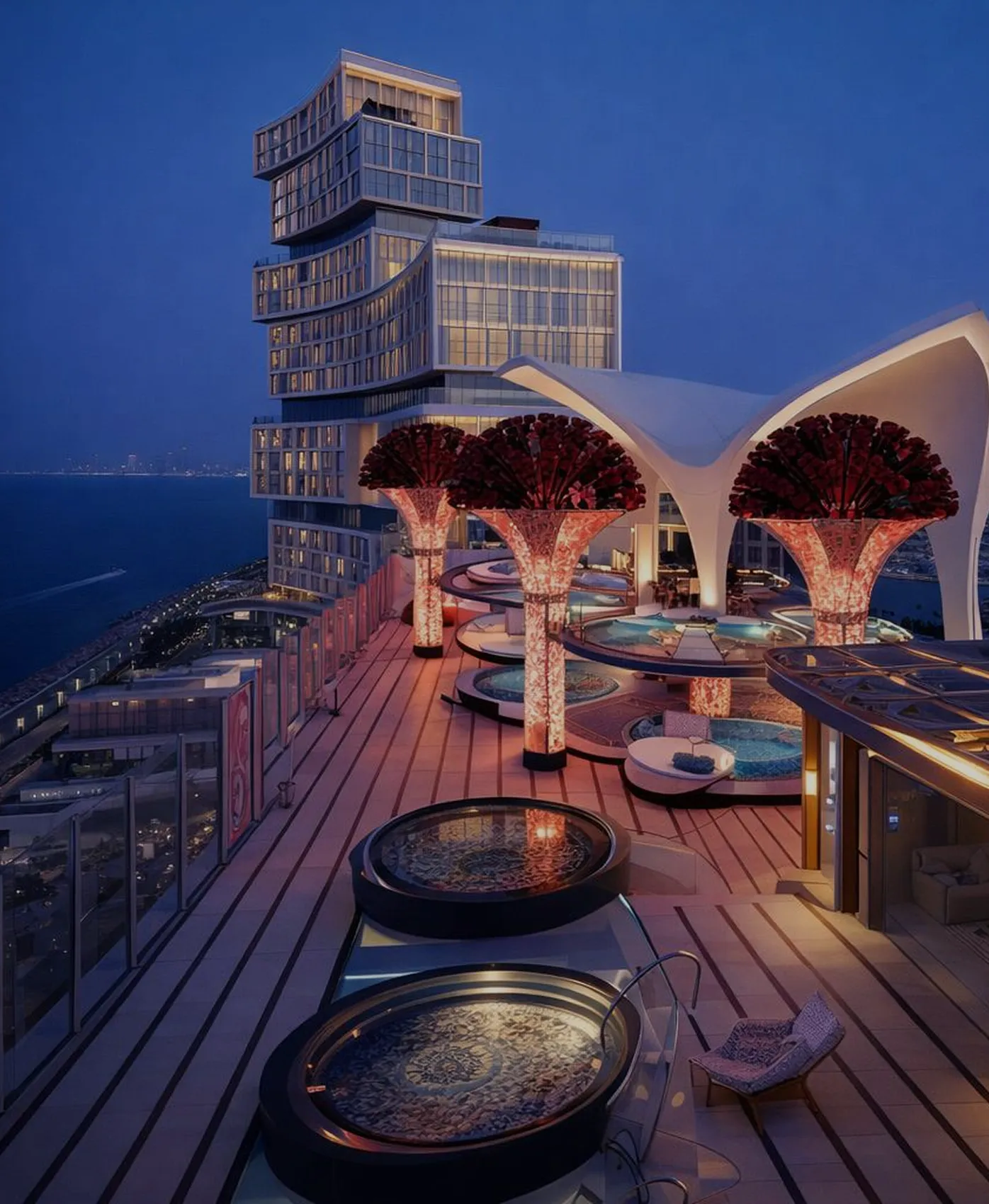

Events & Experiences
Enterprise & Training
Gaming & Education


Screens got personal, and something was lost along the way. This is why the dome, a format that puts an entire audience inside the same story at the same moment, is being built again across the GCC, what it does that a headset cannot, and how to choose the right one.
.png)
.png)
I want to be careful here, because the easy version of this argument is nostalgia, and nostalgia is not a business case. Personal screens are extraordinary. They are also, by design, solitary. When the objective is to move a room full of people, a family, a school group, a delegation, a launch audience, solitary is a limitation, not a feature.
A dome puts everyone inside the same environment at the same moment. That single property changes what the format can achieve, and it is worth understanding properly before deciding whether it fits what you are trying to do.
QUICK ANSWER A headset delivers immersion to one person and isolates them from everyone around them. A dome delivers immersion to an entire audience simultaneously, with no equipment to wear, no hygiene or fitting logistics, and no limit imposed by how many headsets you own.
This is not a criticism of VR. We supply headset-based systems too, and for training, simulation and single-user configuration work they are frequently the correct answer. But the trade-off is real and well documented: headsets provide perceptual isolation from the physical surroundings, and individual headphone use means people standing in the same room are partly acoustically isolated from each other. Research on co-located VR keeps running into the same problem the social part of the experience is the part the hardware interferes with.
A dome inverts every one of those constraints:
• Nothing to wear. No fitting, no hygiene protocol between sessions, no visitors who cannot participate because of glasses, headscarves, motion sensitivity or simple reluctance.
• No hardware ceiling on audience size. Capacity is set by the structure, not by inventory. A large dome seats hundreds; you do not need to buy hundreds of anything.
• Everyone sees the same thing at the same time. Which is the prerequisite for a shared reaction, and shared reactions are what people talk about afterwards.
• Throughput that works commercially. Sessions run on a schedule with a full audience, which is a materially different economic model from queuing individuals through headset stations.
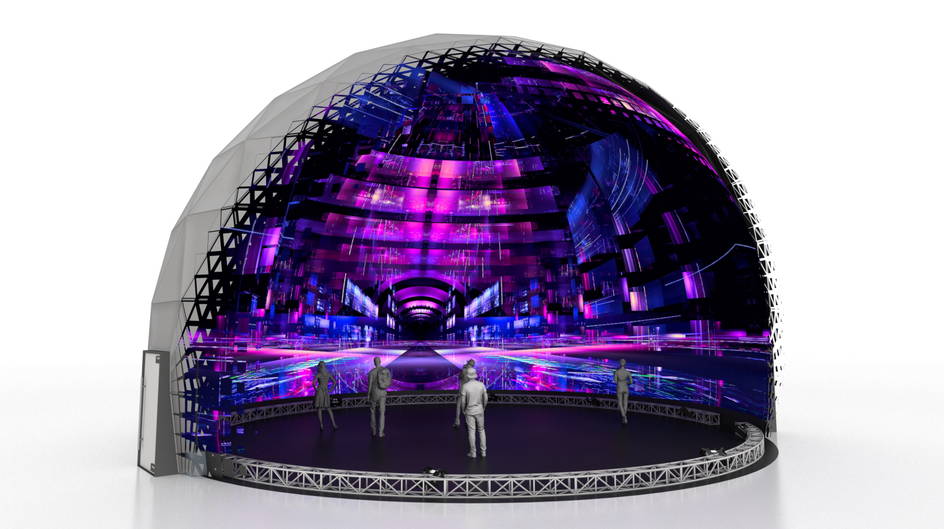
QUICK ANSWER Putting an audience inside one environment together produces collective emotion, conversation, shared memory, longer dwell time, stronger attention, accessibility without equipment, higher capacity, interaction between participants, and a sense of scale that personal devices physically cannot reproduce.
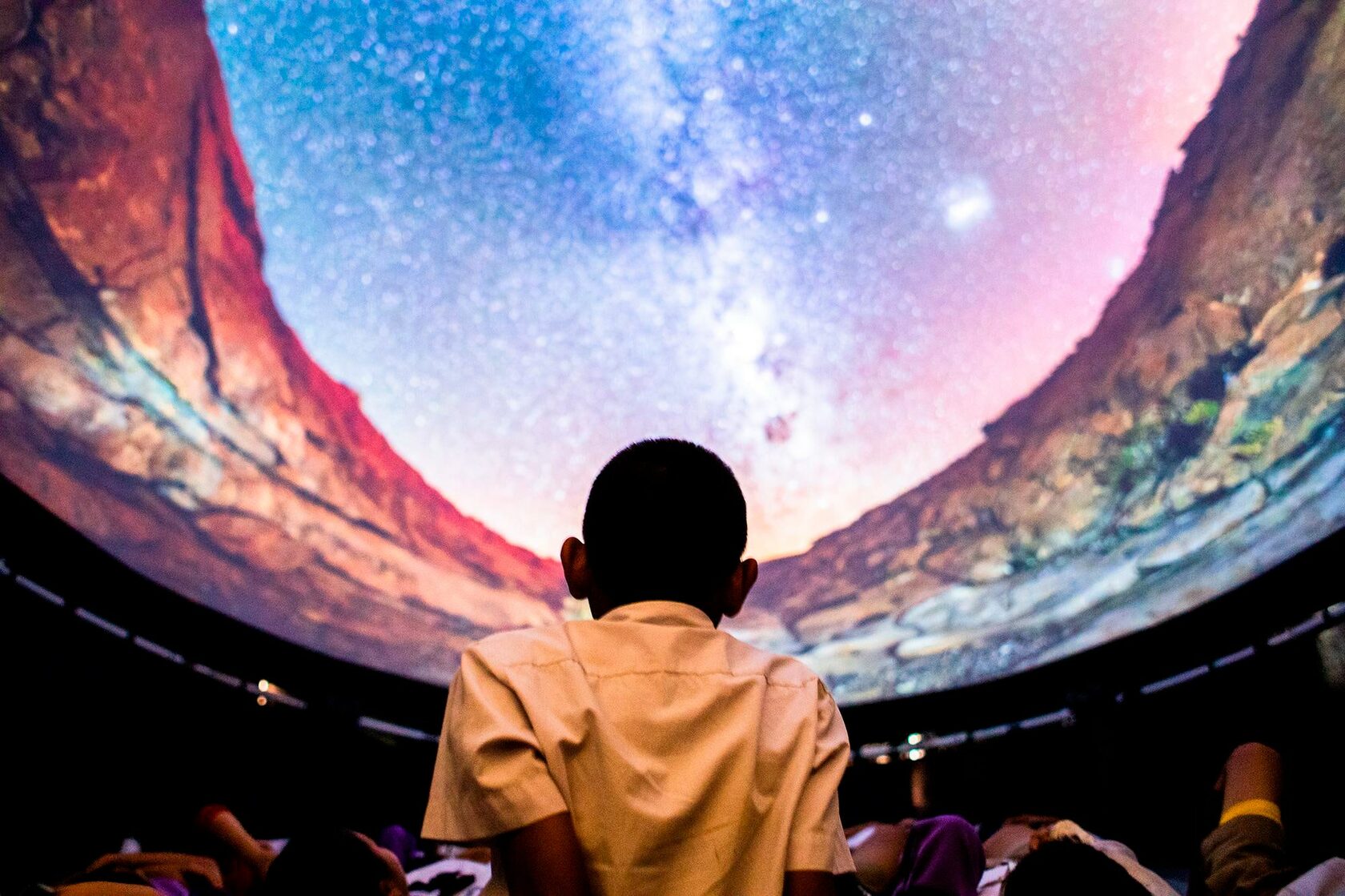
The one I would underline is scale. Every other item on that list can be argued. Scale cannot. When content wraps the full field of view at genuine architectural size, the body responds, people lean back, reach out, lose track of the room. No handheld device reproduces that, however high its resolution, because the effect comes from physical size rather than pixel density.
The second is conversation. A visitor who leaves a private experience has had a private experience. A family that leaves a dome has something to discuss on the way out, and that conversation is the mechanism by which the content actually travels.
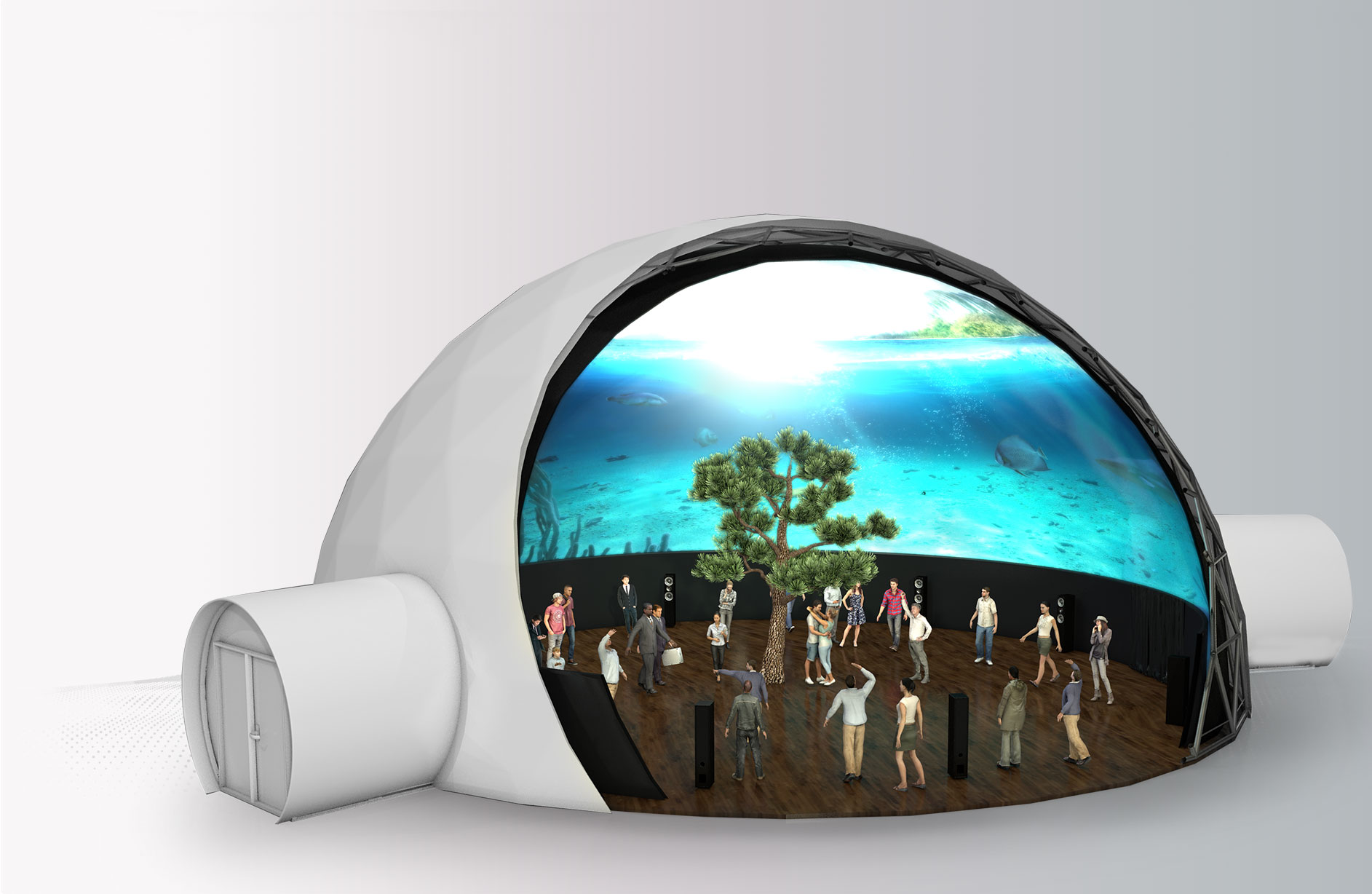
QUICK ANSWER A dome is a canvas, not a fixed attraction. The same physical structure can run education, museum content, tourism storytelling, government narrative, wellness, brand launches, entertainment, exhibitions and corporate events, changing its entire purpose with a change of content rather than a change of build.
This is the property that makes the commercial case work, and it is the one most often missed at planning stage. A cinema is a cinema. A dome is whatever is playing inside it this hour.
Our own most visible example is Beyond Dome at Dubai Festival City Mall, Dubai's first immersive 360° venue, built around a permanent 20-metre geodesic dome. We supplied the dome structures as Fulldome Pro's official partner in Dubai, with Fulldome Pro delivering the projection, media server, calibration and audio systems installed within them. Twelve laser projectors cover the interior surface, with directional spatial audio, across roughly 300 m² of usable hall floor and a maximum capacity of 250 guests.
What matters for this argument is the operating model. That single venue runs family programming through the day, adult sensory experiences in the evening, and converts to host brand launches, private dining and school programmes alongside both. The floor is rated for heavy point loading specifically so vehicles and large set pieces can be brought inside for product premieres. One footprint, several audiences, several revenue lines, no rebuild between them.
That flexibility is the answer to the question every operator asks about a dome, which is what happens when the novelty fades. The honest answer is that novelty always fades. Content is what replaces it, and a dome is unusually good at accepting new content without touching the structure.
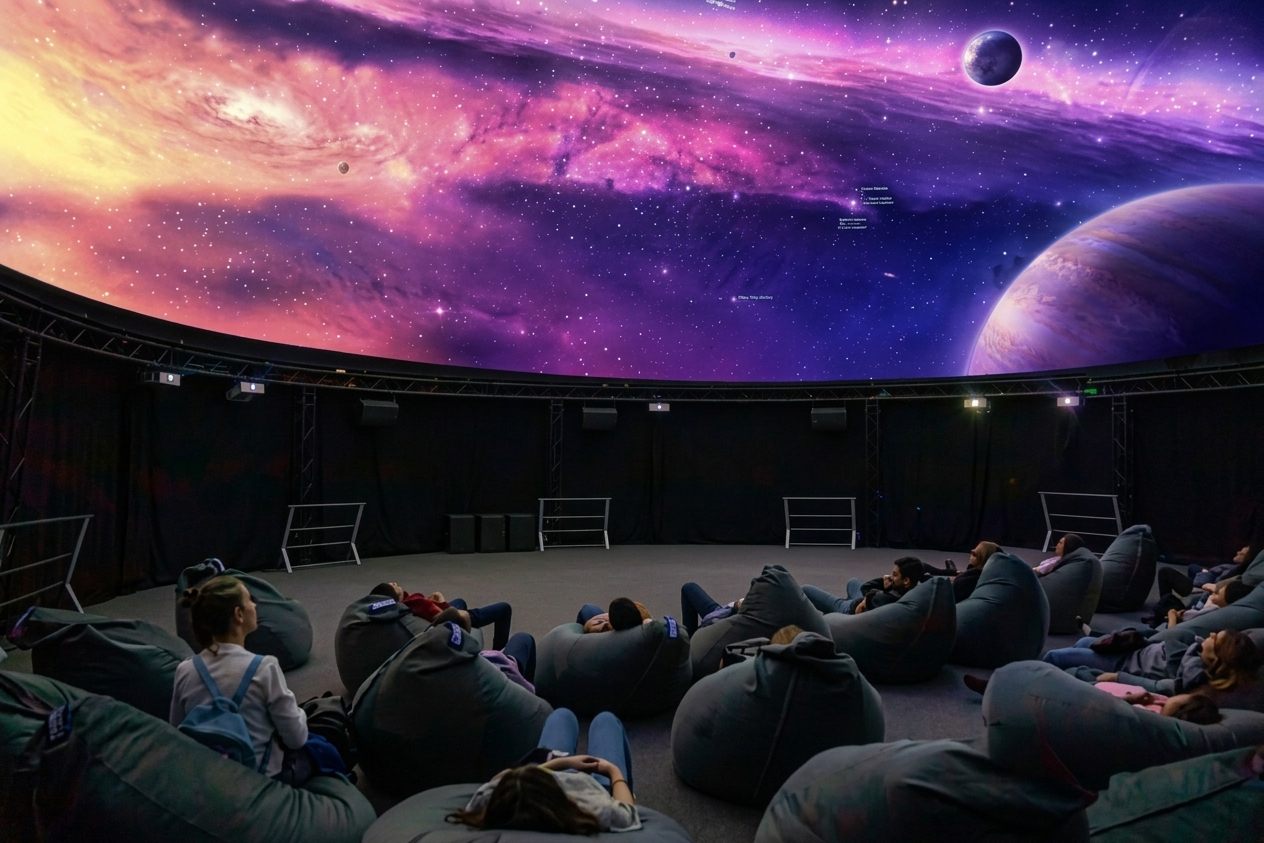
QUICK ANSWER Projection domes scale from around 2.5 metres for a two-person pod to 35 metres for a major venue. Diameter determines capacity, height, projector count and cost, so the size decision should follow from required throughput and content ambition rather than available space alone.
Indicative specifications across the range we supply:
Super Reality Domes run from roughly 4.5 m to 35 m in diameter, on lightweight geodesic frames that suit both temporary and permanent installation.
How to choose. Work backwards from throughput. If you need 400 visitors per hour and your show runs 20 minutes, you need roughly 135 seats per session — which points at 16 m and above, regardless of what the available floor plate might accommodate. Undersizing a dome to fit a room is the most common planning error we see, and it is discovered at the point where the queue forms, which is too late.
A note on temporary versus permanent. An 8 m dome on an exhibition stand and a 20 m permanent venue are the same idea at wildly different engineering standards. Which brings us to the part that is easy to underestimate.
QUICK ANSWER Geometric accuracy, thermal specification, structural rating and calibration tolerance determine whether a dome performs. These are structural decisions made before any projector is chosen, and no projection system can correct a dome that was built wrong.
This is the part of a dome project that never appears in the marketing imagery and decides the outcome anyway.
Geometric accuracy. A multi-projector array is calibrated to the interior surface. If the dome's geometry is out of tolerance, the blend between projectors cannot be made seamless, you get soft seams, doubled edges and a picture that looks subtly wrong in a way audiences feel without being able to name. Get the diameter, geometry or surface wrong and no amount of projector quality recovers it afterwards.
Thermal specification. In this region this is not optional. A dome in continuous public operation in Dubai needs proper insulation specified from the outset, Beyond Dome was built with twin thermal insulation precisely because it runs year-round rather than for a three-day event.
Structural rating. If the business model includes brand launches, the floor needs to carry vehicles and set pieces. That is a specification decided at the beginning, not a request made later.
Projection and audio as one system. Full-field projection and directional spatial audio are what produce the sensation of sitting inside the content rather than in front of it. Specified separately, they rarely land together.
QUICK ANSWER Dome venues are now operating commercially across the region, permanent attractions in Dubai, museum and cultural installations in Abu Dhabi, and event-scale domes at major Saudi conferences supported by strong search demand in both the UAE and Saudi markets.
Beyond Dome opened as Dubai’s first dedicated immersive 360° venue and now operates as a permanent commercial attraction, running public shows alongside private and corporate bookings. In Abu Dhabi, Louvre Abu Dhabi has run dome-format immersive programming as part of its visitor offer. In Saudi Arabia, Super Reality Domes have been deployed at event scale — including at the LEAP technology conference in Riyadh, which is the temporary end of the same capability.
The demand signal supports what we see commercially. Search volume for "immersive dome" runs at roughly 7,000 per month in the UAE and the same again in Saudi Arabia, a rare case of two major GCC markets showing equal appetite for the same format at the same time.
Globally the direction is consistent. The dome projection systems market was valued at roughly USD 285 million in 2023 and continues to grow, with operators such as Cosm scaling toward 30–40 venues in the US by 2030, and geodesic domes now among the most frequently rented structures in the corporate events sector.
QUICK ANSWER Rent when the requirement is an event, a roadshow, a pilot or a seasonal activation. Build when the dome will operate continuously, when the content library justifies a permanent home, or when it anchors a destination.
Rent if: the activation runs days or weeks; you are testing audience appetite before committing capital; the dome tours between cities; or the brief is a single launch moment. A temporary dome can be installed and struck quickly, which is precisely what the geodesic frame is designed for.
Build if: the venue will run scheduled sessions year-round; the operating model depends on switching audiences through the day, as Beyond Dome does; or the dome is the anchor attraction rather than a feature within something else. Permanent domes carry higher specification requirements, insulation, structural rating, serviceability, and correspondingly higher cost, which is recovered through years of operation rather than one campaign.
A middle path worth knowing about. Several operators we work with begin with a rented dome for a season, measure attendance and dwell honestly, and use that evidence to size and justify a permanent build. It is a slower route to the same place, with considerably less risk attached.
QUICK ANSWER Decide the audience and throughput, the content plan beyond opening, whether the venue must convert between uses, the permanence, and who owns content updates. Those five answers determine diameter, specification and cost more than any other factor.
Step 1, Define audience and throughput. Visitors per hour and session length set the diameter. Start here, not with the floor plan.
Step 2, Plan content past opening day. A dome with one show is an attraction with a shelf life. Agree at the outset what changes at three months, at a year, and who produces it.
Step 3, Decide whether it converts. If the model includes corporate hire, launches or dining, that changes floor rating, seating approach, access and power before anything is ordered.
Step 4, Be honest about permanence. Event-grade and year-round-grade are different products. Specifying the first while planning the second is how domes end up needing replacement early.
Step 5, Name the content owner. The venues that stay relevant are the ones where somebody is accountable for what plays inside, with a budget to match.
QUICK ANSWER Power Interactive is the official Fulldome Pro partner in Dubai, supplying and installing projection dome systems from compact pods to 35-metre venues across the UAE, Saudi Arabia and Oman, with more than 800 experiential technology projects delivered since 2018.
Our position on domes is structural in both senses. As Fulldome Pro's official Dubai partner we supply the dome systems themselves, and on Beyond Dome that put us on the structural side of the delivery — specifying and installing the domes into a live retail environment, coordinating access, build sequencing and handover so the projection and audio installation could proceed inside a structurally complete and correctly aligned dome.
We supply the full size range. From compact retail pods through to large-format permanent venues, for purchase or rental, temporary or permanent.
We specify for this region. Thermal load, year-round operation, and the logistics of installing inside working venues are design inputs here, not afterthoughts.
We deliver the content as well as the canvas. Our content and app development team produces fulldome material built for the format rather than adapted to it which, as with any immersive canvas, is usually the difference between a venue that impresses once and one that people return to.
The track record is regional and specific. More than 800 delivered projects since 2018 across the UAE, Saudi Arabia, Oman and the wider GCC, for clients including DEWA, the Government of Dubai, Atlantis The Royal, Emaar, Dubai Future Foundation and Louis Vuitton.
Some of the most powerful immersive experiences are the ones people experience together.
That is not a slogan, it is the reason this format keeps returning while more private technologies come and go.


A hemispherical venue in which projection covers the full interior surface, so the audience sits inside the content rather than facing a screen. Combined with directional spatial audio, it produces a sense of presence that flat-screen formats cannot reach, for an entire audience simultaneously and with no equipment to wear.
VR delivers immersion to one person wearing a headset, which perceptually and acoustically isolates them from everyone around them. A dome delivers immersion to a whole audience at once, with nothing to wear and no per-person hardware. VR is often the better answer for training and simulation; a dome is the better answer when the objective is a shared audience experience.
From roughly 2.5 m for a two-to-four person pod up to 35 m for a flagship venue. As a guide, an 8 m dome seats around 23 people, a 12 m around 78, a 16 m around 140, and a 21 m around 224. Diameter should be chosen from required throughput rather than available floor space.
Yes, and this is the format's main commercial advantage. The same structure can run education, museum, tourism, government, wellness, entertainment, brand and corporate content. Beyond Dome in Dubai runs family programming by day, adult experiences in the evening, and converts for brand launches, private dining and school programmes.
Rent for events, roadshows, pilots and seasonal activations. Buy when the dome will run year-round, when it anchors a destination, or when the content plan justifies a permanent home. Renting first to validate audience demand before committing to a permanent build is a common and sensible route.
Geometric accuracy above all a multi-projector array can only be blended seamlessly across a dome built to tolerance. After that: thermal specification for continuous operation in this climate, structural and floor rating matched to the intended uses, and projection and audio designed as one system. These are decided before any projector is selected and cannot be fixed afterwards.
It depends on diameter and required resolution. As a reference point, the 20-metre dome at Beyond Dome uses a twelve-projector laser array calibrated across the full interior surface. Smaller domes may need only one or two.
Yes, provided they are specified for it. A dome in continuous year-round public operation needs proper thermal insulation designed in from the start Beyond Dome uses twin thermal insulation for exactly this reason. A dome specified for temporary event use will not perform the same way over years of operation.
.png)
We design and build immersive experiences that engage, excite and transform audience interaction combining art, engineering, and next-gen technology to bring brands and spaces to life.