Services

Tech Concepts
Events & Experiences
Enterprise & Training
Gaming & Education


Most experience centres don't fail on opening day. They date quietly, when content can't change and systems can't evolve. This guide explains how modular hardware, flexible content management, AI-ready architecture and planned upgrades keep an experience centre relevant for years.

An experience centre is one of the largest single investments a corporate, government or destination client will make in physical storytelling. The biggest risk is not that the technology is too modest. It is that the space is technologically impressive on launch day but built in a way that cannot evolve.
This guide explains how to design an experience centre that stays relevant for years: modular hardware, flexible content management, AI-ready architecture, adaptable visitor journeys, monitoring, AMC and upgrade planning. It is written for the people who have to justify the investment, run the space after handover and still be proud of it in year five.
QUICK ANSWER: Experience centres rarely date because the hardware stops working. They date because the content is fixed, the software is hard-coded, the systems depend on single components, and the client team cannot change anything without outside help. The space stops evolving, so visitors stop finding a reason to engage.
When a client tells us their experience centre feels dated, the screens are usually still bright and the media servers are usually still running. What has changed is everything around them.
The company has launched new products. The government programme has moved into its next phase. The audience has changed from investors to delegations to internal teams. Yet the space is still playing the same film, offering the same touchscreen menu and telling the same story it told at the ribbon cutting.
There are four common causes, and none of them is about display resolution:
Fixed content. The experience was produced as a single launch piece rather than a content system, so updating it means commissioning a new production.
Hard-coded software. Products, data and stories were written directly into the application, so adding one item becomes a development project.
Single points of dependency. One sensor, one player or one proprietary device sits underneath an entire interaction, so when it is discontinued, the experience goes with it.
No operational ownership. The client team was never given the tools or training to run the space, so nothing changes unless an external partner is called in.
The good news is that every one of these is a design decision. They can be avoided before a single piece of equipment is specified.
QUICK ANSWER: A future-proof experience centre is one designed so that content, software and individual hardware components can be updated, replaced or extended without rebuilding the whole system. It does not mean buying technology that will never age. That technology does not exist.
Clients often ask us which display, which projector or which AI platform will still be current in five years. It is the wrong question, and an honest integrator should say so.
Displays will get brighter and finer. Processing will get faster. AI will change how people interact with physical spaces in ways nobody can specify today. Trying to predict exactly what will happen is unrealistic.
A more useful definition of future-proofing is designing the system so change remains possible. Good experience centre design does not stop technology from ageing. It prevents one ageing component from making everything around it obsolete.
That shifts the brief from "What is the most impressive thing we can install?" to "What will make this space worth visiting, and worth operating, three years from now?"
QUICK ANSWER: Modular hardware means each part of the system, such as displays, media servers, sensors and control processors, can be serviced, replaced or upgraded independently. It protects the investment because a failed or discontinued component becomes a swap, not a redesign.
In a modular experience centre, the system is designed as a set of layers that talk to each other through standard connections rather than as one inseparable installation.
In practice that means:
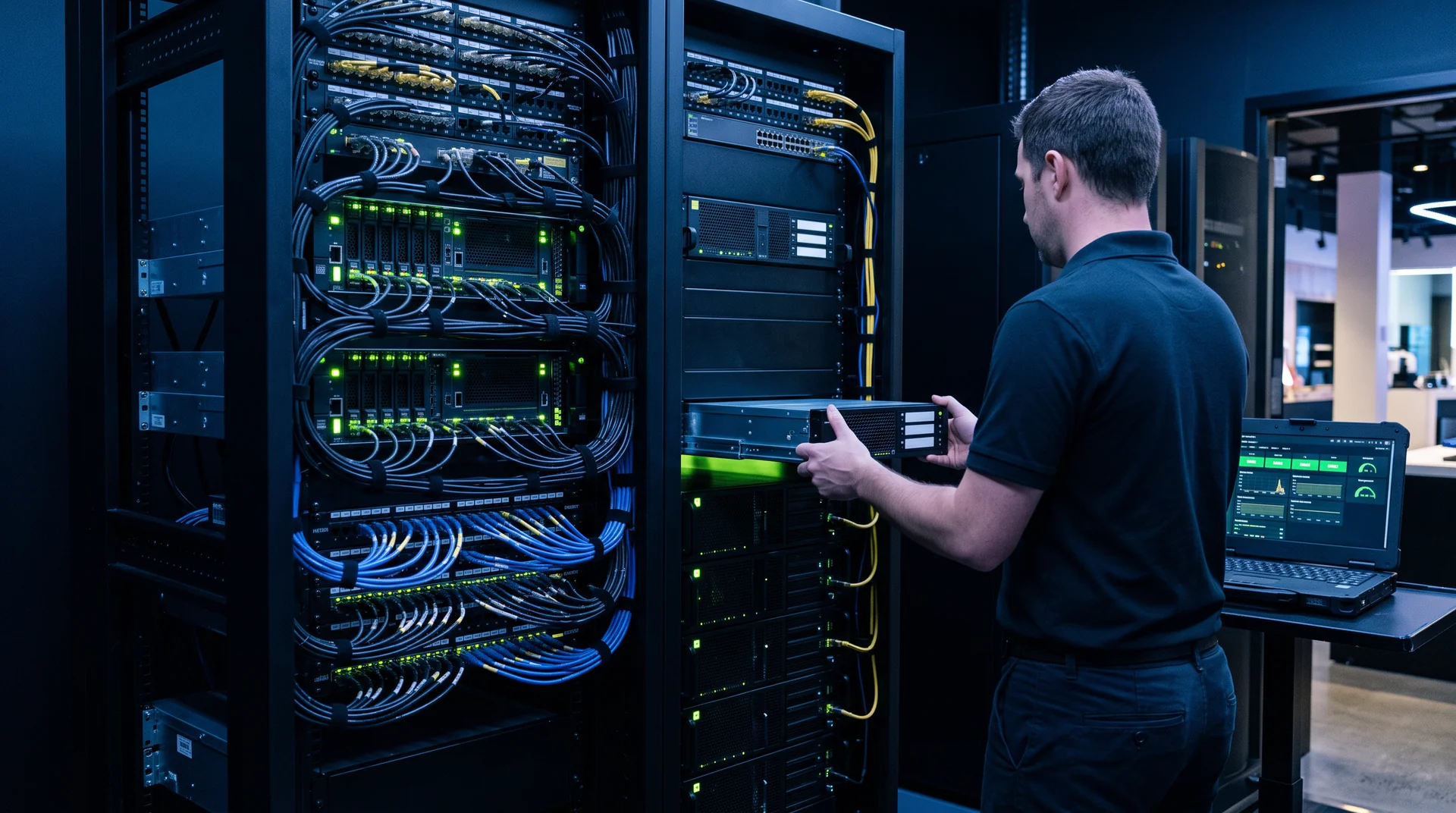
Displays and processing are separated. If a media server reaches end of life, it can be replaced without rebuilding the LED wall or re-mapping every piece of content.
Interactions do not depend on one sensor model. If a particular camera or tracking device leaves the market, a compatible alternative can be integrated without redeveloping the experience.
Standard, documented connections. Signal, network and control paths use widely supported standards so future equipment can plug into the same infrastructure.
Physical service access. Every component that will one day need replacing can actually be reached. A beautifully integrated projector that requires removing part of the ceiling to service has a maintenance problem long before it fails.
Modularity also makes upgrades proportional. When a better display technology arrives, you can upgrade the hero surface first and leave the rest of the space untouched, rather than facing an all-or-nothing refit. Our permanent interactive installations are specified on this basis.
QUICK ANSWER: A flexible content management system (CMS) lets your own team update, schedule and swap content across every screen in the experience centre without a developer. It is the single biggest factor in whether a space stays current, because content dates far faster than hardware.
If hardware is the canvas, content is what visitors actually remember. And content is what ages first.
A beautifully produced immersive film can be perfect at launch. Play it every day for four years and it becomes part of the background. Permanent spaces need a content strategy, not only launch content.
That is why we treat the CMS as core infrastructure rather than an optional extra. A well-designed content management layer should let the operating team:
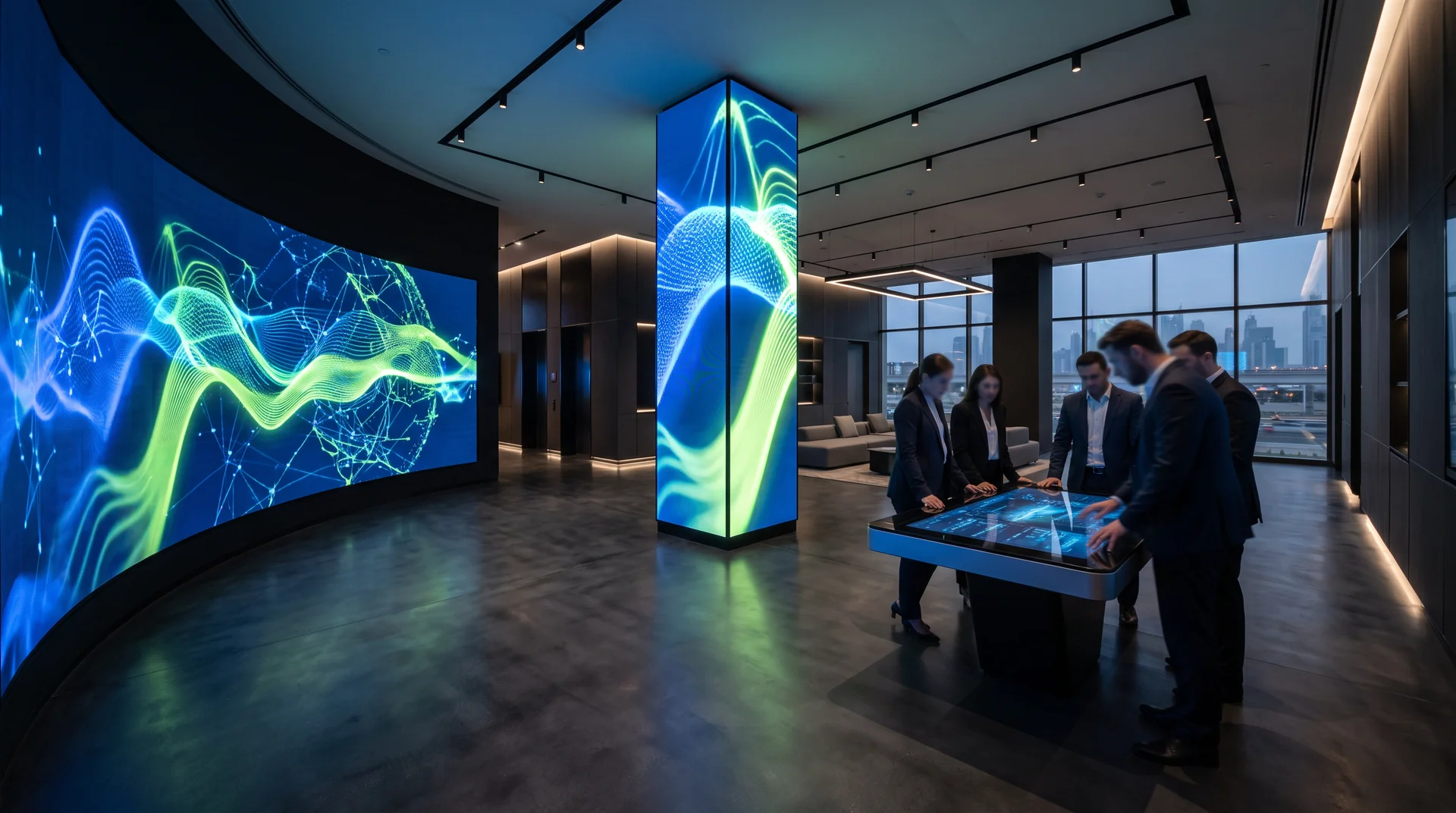
The PwC Immersive Experience Center in Riyadh is a clear example of why this matters. The space is used by government delegations, executive teams, clients and partner organisations, so it could not be designed around one fixed presentation. Power Interactive developed interactive content for the large-format LED walls, bespoke content for the four-sided LED pillar, dedicated media-server infrastructure and a centralised content management system. The PwC team now prepares and runs the environment themselves.
One audience can experience one story today. Another can experience something completely different tomorrow. The physical infrastructure stays the same.
That is where much of the return on investment comes from. Instead of paying for one experience, the client has invested in a platform that supports many experiences over its lifetime. Our content and app development team builds both the content and the systems that manage it.
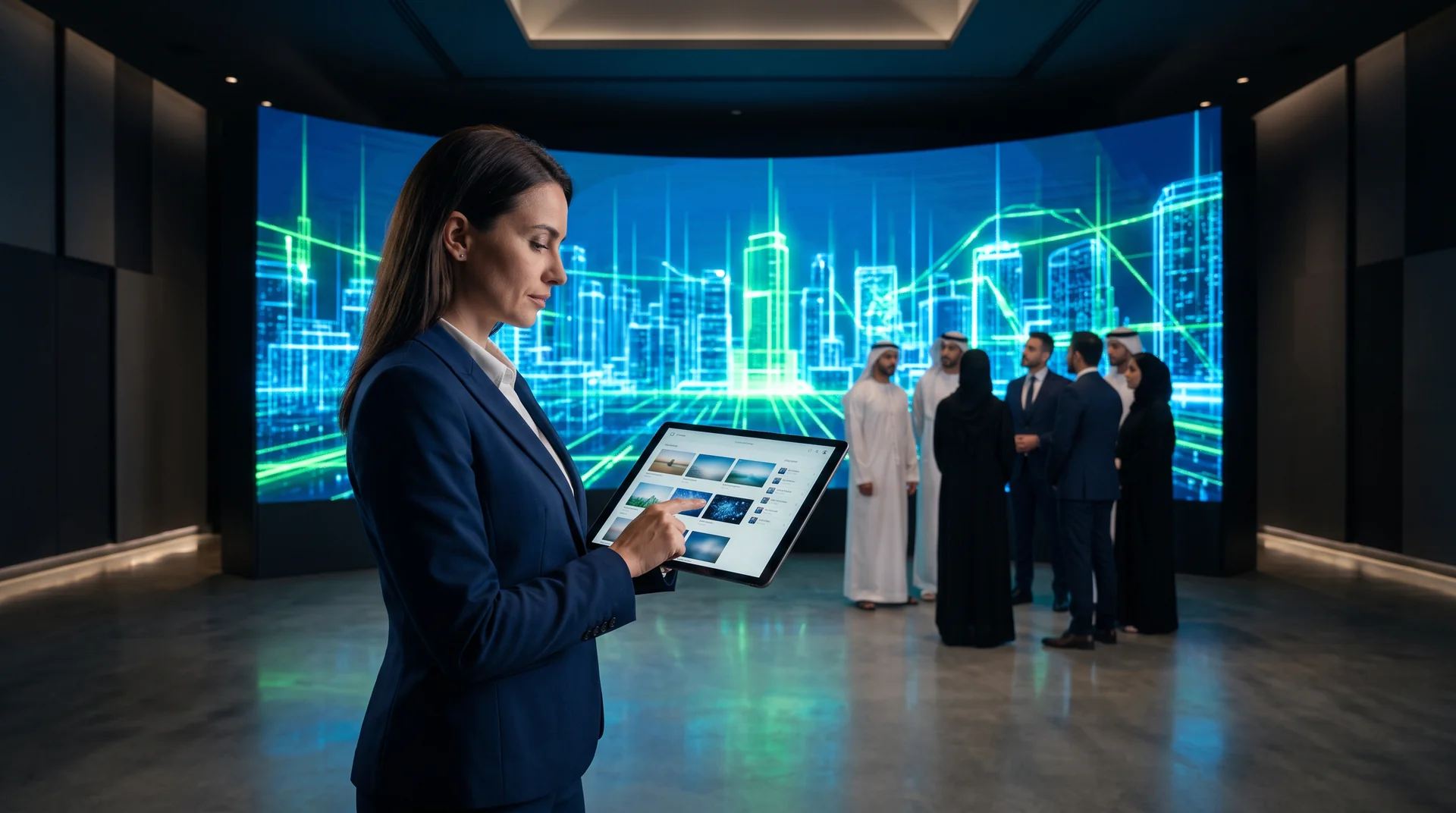
QUICK ANSWER: An AI-ready experience centre is built on open software architecture, with APIs, structured content and network capacity, so that AI assistants, live data feeds and new interactive features can be added later without rebuilding the core system.
Many organisations planning an experience centre today already expect to add AI. Few know exactly what form it will take. That uncertainty is precisely why the architecture matters more than any single AI feature at launch.
Three foundations make an experience centre ready for AI and live data:
API integration. Software built around application programming interfaces (APIs) can connect to new services, such as AI models, CRM platforms, booking systems or analytics tools, without being rewritten.
Structured content. When products, stories and data live in a database or CMS instead of being hard-coded, an AI assistant can draw on that same information to answer visitor questions in natural language.
Real-time data connections. Live dashboards, project progress, energy use, operational metrics or market data keep a space current automatically, because the content updates itself.
Consider an interactive product table launched with ten products. Three years later there are thirty. If every product was hard-coded, adding twenty becomes another development exercise. If the system was built around a flexible database, the client team adds them internally. The visitor sees an interactive table either way. The ownership experience is completely different.
The same principle applies to AI. An organisation may decide in year three that it wants a conversational AI guide in a space that was designed before that requirement existed. With open architecture, that is an upgrade. Without it, it is a rebuild. We explore where this is heading in how AI is changing physical experiences.
QUICK ANSWER: An adaptable visitor journey lets the same experience centre deliver different routes, stories and durations for different audiences, from a 15-minute executive walkthrough to a half-day workshop, by changing content and sequence rather than the physical space.
A government delegation visits in the morning. An international client arrives in the afternoon. The next day, the same space hosts an internal strategy session. If the environment can only tell one story, its usefulness is immediately limited.
Adaptable journeys are designed in from the start:
Modular storytelling. Content is built as chapters that can be reordered, shortened or extended, rather than one linear film.
Audience presets. The operator can select a journey for investors, students, partners or officials, and the space reconfigures itself across every surface.
Flexible zones. Areas can be used for guided presentations, self-guided exploration, hospitality or workshops, without permanent physical changes.
Simple operator control. A receptionist, facilitator or marketing manager can run the journey from a tablet. The technology underneath can be sophisticated. Operating it should feel simple.
This also changes how often people come back. When a returning client finds a space prepared specifically for them, the experience centre stops being a showroom and becomes a working tool.
QUICK ANSWER: Scalable infrastructure means the network, power, processing and control systems have spare capacity for future screens, sensors and features. System monitoring means faults are detected and reported automatically, often before visitors notice, so the space stays reliable as it grows.
In a permanent experience centre, Professional AV is not event equipment that happens to stay installed. It becomes part of the building, and it has to be planned like building infrastructure.
Scalability questions worth asking at design stage:
Monitoring is the other half. In an experience centre, there is usually no engineer in the building. A fault discovered by a visitor, reported to reception and escalated days later damages the experience and the brand. A monitored system notices the problem itself, alerts the support team and often allows remote diagnosis or a fix before anyone on site is aware.
Our Pro AV solutions are designed around this principle: the guest should never think about the network, racks, signal distribution or control systems. They should simply experience the space, every day.
QUICK ANSWER: An Annual Maintenance Contract (AMC) keeps an experience centre running through preventive servicing, monitoring and support, while an upgrade roadmap plans when content, software and hardware will be refreshed. Together they turn a one-off installation into an asset that stays current over its lifetime.
Maintenance should start during design, not after the first failure. Even the best AMC cannot fully compensate for a space that was difficult to maintain from the beginning. A good support strategy keeps a system working. Good design makes that system easier to support.
A strong experience centre AMC typically covers:
Alongside the AMC, we recommend agreeing an upgrade roadmap at handover, so future investment is planned rather than reactive:
| Stage | Focus | Typical activities |
|---|---|---|
| Launch | Stability and ownership | Commissioning, documentation, operator training, CMS handover |
| Year 1 | Refine | Review visitor behaviour, adjust journeys, add first content updates |
| Years 2–3 | Refresh | New content chapters, software features, possible AI or live-data integration |
| Years 4–5 | Renew | Replace end-of-life components, upgrade hero displays, re-evaluate the story |
The exact timing depends on operating hours, content strategy and how fast the organisation's own story changes. What matters is that the conversation happens before the space opens, not after it starts to feel dated. We cover maintenance contracts in more depth in Permanent Installation vs Event Activation.
QUICK ANSWER: The difference between an experience centre that dates in two years and one that stays relevant is rarely the budget. It is whether each layer, from hardware and software to content and support, was designed for change.
| Decision | Built to date | Built to evolve |
|---|---|---|
| Hardware | Integrated as one fixed system | Modular, independently replaceable components |
| Content management | Changes need a developer | Client team updates content through a CMS |
| Content | One launch film on repeat | A content strategy with planned refreshes |
| Software | Hard-coded products and data | Database-driven, built around APIs |
| AI readiness | Not considered | Open architecture ready for AI and new services |
| Real-time data | Static information | Live data feeds keep content current |
| Component dependency | One device underpins an interaction | Alternatives can be integrated |
| Content updates | On-site, by specialists | Remote content updates from one place |
| Visitor journeys | One fixed route | Adaptable journeys for different audiences |
| Infrastructure | Sized for launch only | Spare capacity for growth |
| Monitoring | Faults found by visitors | Faults detected and reported automatically |
| AMC | Reactive call-outs | Preventive maintenance with defined response times |
| Upgrade planning | Considered when it feels dated | Roadmap agreed at handover |
QUICK ANSWER: Before specifying technology, ask how content will be updated, who will operate the space, what happens when components are discontinued, whether AI and live data can be added later, and how support and upgrades are planned. The answers reveal whether a proposal is built to last.
If you are still at the briefing stage, our guide on how to brief an immersive experience project and the complete guide to experience centres are useful companions to this checklist.
QUICK ANSWER: Power Interactive designs, produces and integrates experience centres as evolving platforms: modular Pro AV infrastructure, content and CMS the client team can run, software architecture ready for AI and live data, and AMC support with an upgrade roadmap agreed from the start.
We bring consultancy, experience design, content production, interactive software and Professional AV together under one roof, which means the decisions that make a space future-proof are made together rather than handed between separate suppliers.
We start with the outcome. Who will visit, what they should understand, and how that will change over the next five years shape the technology, not the other way around.
We design for the operator, not only the visitor. The people running the space get a CMS and controls they can use confidently, as the PwC team does in Riyadh.
We build software that can grow. Database-driven, API-ready applications that can take on new content, features and AI without starting again.
We engineer the infrastructure for the long term. Modular hardware, spare capacity, service access, monitoring and documentation, specified for daily operation in GCC conditions.
We stay involved after handover. Preventive maintenance, remote support and a planned upgrade roadmap through our AMC programme.
If you are planning an experience centre in Dubai, the UAE, Saudi Arabia or elsewhere in the GCC, these are conversations worth having before the technology is specified. Tell us about your space, audience and objectives, and we will help you design something that still earns its place in year five.
More than 800 delivered projects since 2018 across the UAE, Saudi Arabia, Oman and the wider GCC, for clients including Atlantis The Royal, Al Jalila Foundation, VISA, PwC, Emaar, DEWA, the Government of Dubai and Dubai Desert Conservation Reserve.
Author Mohamed Sorkatti is Director of Operations at Power Interactive, a Dubai-based immersive technology studio. This article draws on more than 800 experiential technology projects designed, engineered and delivered by Power Interactive across the UAE, Saudi Arabia, Oman and the wider GCC since 2018.


The physical infrastructure of a well-engineered experience centre can serve for many years, but content and software usually need attention much sooner. Without a content strategy and a flexible CMS, many spaces start to feel dated within the first couple of years. Planning content refreshes and an upgrade roadmap from day one keeps the space relevant for its full lifetime.
A future-proof experience centre is designed so change remains possible. That means modular hardware that can be replaced component by component, a content management system the client team can run, software built around APIs and structured data, spare infrastructure capacity, system monitoring, and an AMC with a planned upgrade roadmap.
Content dates faster than hardware. A CMS lets your own team update, schedule and swap content across every screen without a developer, prepare the space for different audiences, and push remote content updates. Without one, every change becomes a paid production or development job, so the space usually stops changing.
Yes, if the original software was built on open architecture with APIs and structured content. In that case an AI assistant or live data feed can draw on information that already exists in the system. If products, stories and data were hard-coded into the application, adding AI usually means redeveloping significant parts of the experience.
Modular AV hardware means displays, media servers, sensors, control processors and network equipment are designed as independent, standards-based parts. When one reaches end of life or is discontinued, it can be replaced or upgraded without rebuilding the rest of the system or redeveloping the content.
It depends on how often your audience returns and how quickly your own story changes. A space that hosts repeat clients or delegations needs more frequent updates than one visited mostly by first-time guests. We recommend reviewing content at least once a year and building the CMS so smaller updates can happen whenever they are needed.
A strong AMC should include scheduled preventive maintenance, remote monitoring and support, clear response and resolution times, software updates and security patching, a spare-parts strategy for critical components, and operator training as staff change. Confirm whether replacement parts are included or charged separately.
Yes. Planning upgrades at the design stage is far more cost-effective than reacting once the space feels dated. Agreeing a roadmap for content refreshes, software features and hardware renewal at handover makes future investment predictable and ensures the infrastructure has the capacity to accept those upgrades.


Power Interactive is a Dubai-based experiential technology company, building immersive experiences, interactive installations and Pro AV systems for clients across the UAE, Saudi Arabia and the GCC.